The Challenger Customer — Cliff Notes Summary
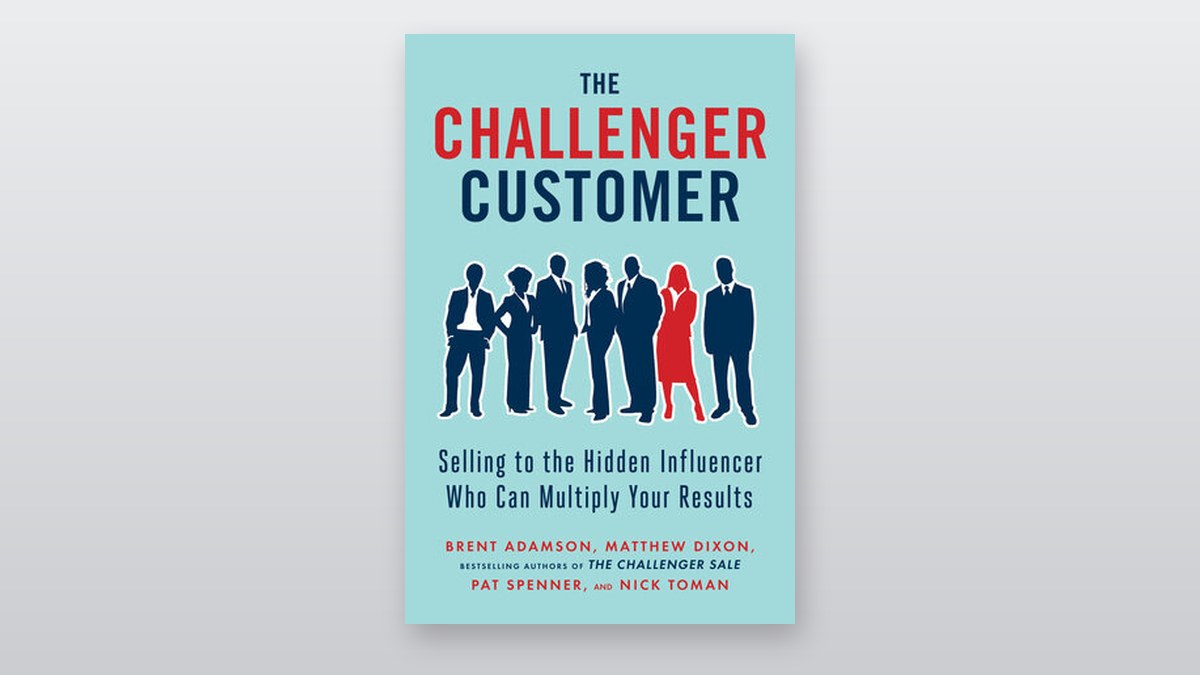
The Challenger Customer: Selling to the Hidden Influencer Who Can Multiply Your Results is the 2015 follow-up to The Challenger Sale, by Brent Adamson, Matthew Dixon, Pat Spenner and Nick Toman, all of CEB. Its main point is that how you sell matters less than whom you sell to. Business purchases are now made by groups, so the authors say the best sellers look for the one stakeholder who can move that group toward a decision, which they call a Mobilizer, and equip that person to carry the deal internally. Friendly contacts who share information but cannot build agreement (Talkers) and people who resist change (Blockers) are the ones to recognize and not rely on.
The book facts below come from the publisher's page: Portfolio imprint of Penguin, published September 8, 2015, 288 pages in hardcover, per the Penguin Random House product page. This is a summary in our own words, based on the public pages linked below, not a chapter-by-chapter retelling. It is a different book from The Challenger Sale.
Challenger Customer vs. Challenger Sale
The two books share authors and a research base, but they ask different questions. The Challenger Sale is about the seller: which style of rep wins, and why a rep who teaches, tailors and takes control tends to outperform. The Challenger Customer is about the buyer: which person inside the customer should that rep spend time on. The Apple Books description puts it as success depending on which customers you challenge, as well as on taking a challenging approach.
The Summary.com review adds why the authors wrote it: the earlier book focused on individual buyers, while the authors argue that B2B purchases are now made by committees. For the seller-side book, see our Challenger Sale summary.
The problem: buying by committee
According to the Summary.com review of the book, the authors say the average B2B sale involves 5.4 people. That is the book's claim, not our own figure, and the Challenger Inc. blog describes complex purchases as a "consensus buy" where the real question is how the group will buy together, not who the one decision-maker is.
The authors argue that trying to customize the pitch for every stakeholder backfires. It is slow, their research indicates more individual tailoring tends to lower the overall quality of the sale, and when the group finally meets, each member holds a separate version of the deal. Those versions conflict, and the sale often collapses.
The core idea: find the Mobilizer
From thousands of surveys, the authors sorted stakeholders into seven profiles, according to the Summary.com review and Challenger Inc.'s own description of the research. Challenger Inc. adds that the original study used 700 stakeholders who rated themselves on 135 attributes. The seven profiles fall into three groups:
- Mobilizers (Go-Getter, Teacher, Skeptic): they have the influence to move the group toward agreement, and they also challenge the seller. Go-getters push to act, teachers push to understand, and skeptics push to test. They are curious, often vendor-neutral and care about the organization, not only themselves.
- Talkers (Guide, Friend, Climber): easy to reach, happy to take meetings and share information, and often voicing support, but unable to build consensus or drive large-scale change.
- Blockers: rarely helpful to a vendor, resistant to change, and able to slow a deal.
The two customer traits that mattered most to top-performing sellers, per Challenger Inc., were the ability to drive change across the organization and the ability to build consensus among colleagues. Mobilizers have both. Challenger Inc. attributes to CEB research the claim that sellers who target Mobilizers are 31% more likely to be high performers.
How to spot a Mobilizer
Challenger Inc. says the label depends on how a person responds to a commercial insight, not on job title, so a Mobilizer can sit at any level. Signs it lists:
- They push back. They ask probing questions and test whether your insight applies to their organization.
- They say "we". They talk about collective concerns rather than only their own.
- They are trusted. Colleagues listen to them and they can make introductions.
- Talkers and Blockers look different. A Talker engages but does not challenge; a Blocker seems bored, asks little and shares little.
A pleasant, responsive contact is not the same as a Mobilizer. The warning in the sources is that the friendliest person is often a Talker.
Commercial insight and commercial coaching
The authors extend the teach, tailor and take-control approach from the first book, per the Summary.com review. A seller teaches with a commercial insight that helps the customer succeed, tailors the message to the type of Mobilizer in front of them, and then equips that Mobilizer to tailor the message for their own colleagues, so the Mobilizer takes control of the internal sale.
Challenger Inc. calls the supporting work commercial coaching: giving the Mobilizer insights, helping them manage the buying group, and guiding them through purchase steps and hurdles. It also contrasts what sellers track. Core performers watch their own activity, such as sending pricing or demos, while Challengers watch the customer's actions, such as implementation questions, consensus building and a budget case. Challenger Inc. describes a thought-provoking commercial insight as the way to activate a Mobilizer, and its 2019 blog adds that winning over a skeptical Mobilizer usually takes constructive tension in the conversation.
What it means for sellers
This section is our own interpretation of the ideas, not something the book says.
- Map the group, then find one champion. Instead of pitching each stakeholder separately, look for the person who can carry one shared version of the deal.
- Do not mistake access for influence. If your best relationship is with someone who only shares information, ask what they can actually move.
- Lead with a point of view. A sharp insight about the customer's business gives a skeptical Mobilizer something to test, which generic product talk does not.
- Give the champion tools. Help them explain the case to colleagues and handle the purchase steps, rather than doing all of the persuading yourself.
- Measure customer progress. Track what the buying group is doing, such as stakeholder agreement and budget, not only what you have sent.
Our summary of the earlier book covers the seller side: The Challenger Sale summary.
Limits to keep in mind
The profile research and the performance claims come from the authors and their employer, and the pages we read repeat those claims; we did not find an independent test of them. Figures such as the 5.4-person buying group date from the book's research period, and Challenger Inc.'s later material uses larger group sizes, so treat any group-size number as a rough guide. We also did not find a source describing the book's treatment of topics such as unlearning old assumptions or making purchases easier for the buying group, so this summary does not cover them. Read the book itself for the full framework and the diagnostic tools.
Questions people ask
What is The Challenger Customer about?
It argues that B2B sellers do best when they focus on the right person inside a buying group, the Mobilizer who can build consensus and push for change, and equip that person to sell internally.
Who wrote The Challenger Customer and when?
Brent Adamson, Matthew Dixon, Pat Spenner and Nick Toman, published September 8, 2015 by Portfolio, an imprint of Penguin.
How is it different from The Challenger Sale?
The Challenger Sale is about the seller's style. The Challenger Customer is about which customer stakeholder to target. See our Challenger Sale summary for the first book.
What are Mobilizers, Talkers and Blockers?
Mobilizers can move a group toward agreement and also challenge the seller. Talkers are friendly and share information but cannot build consensus. Blockers resist change and slow deals.
Is this a substitute for reading the book?
No. It is an independent summary in our own words from public pages. It is not affiliated with the authors, the publisher or any study-guide brand.
Sources
- Penguin Random House: The Challenger Customer · Authors, imprint, publication date, page count and publisher description
- Apple Books: The Challenger Customer · Publisher, release date and description
- Summary.com: Book Review, The Challenger Customer · Buying group size, seven profiles, teach-tailor-take-control extension
- Challenger, Inc.: Mobilizers, Talkers, and Blockers · Research basis, how to identify a Mobilizer, commercial coaching
- Challenger, Inc.: Understanding The Challenger Customer · Consensus buy and Mobilizer traits
- Our Challenger Sale summary · The earlier book by the same authors
This summary is an independent explainer written in our own words and does not reproduce the book. "Cliff notes" here only describes the short format; we are not affiliated with any study-guide brand. Facts were read from the linked pages on October 30, 2026; we did not read the full text of the book. Read the book for the full detail.
Top photo: Book cover via Penguin Random House