The Challenger Sale Summary: Key Ideas in 2027
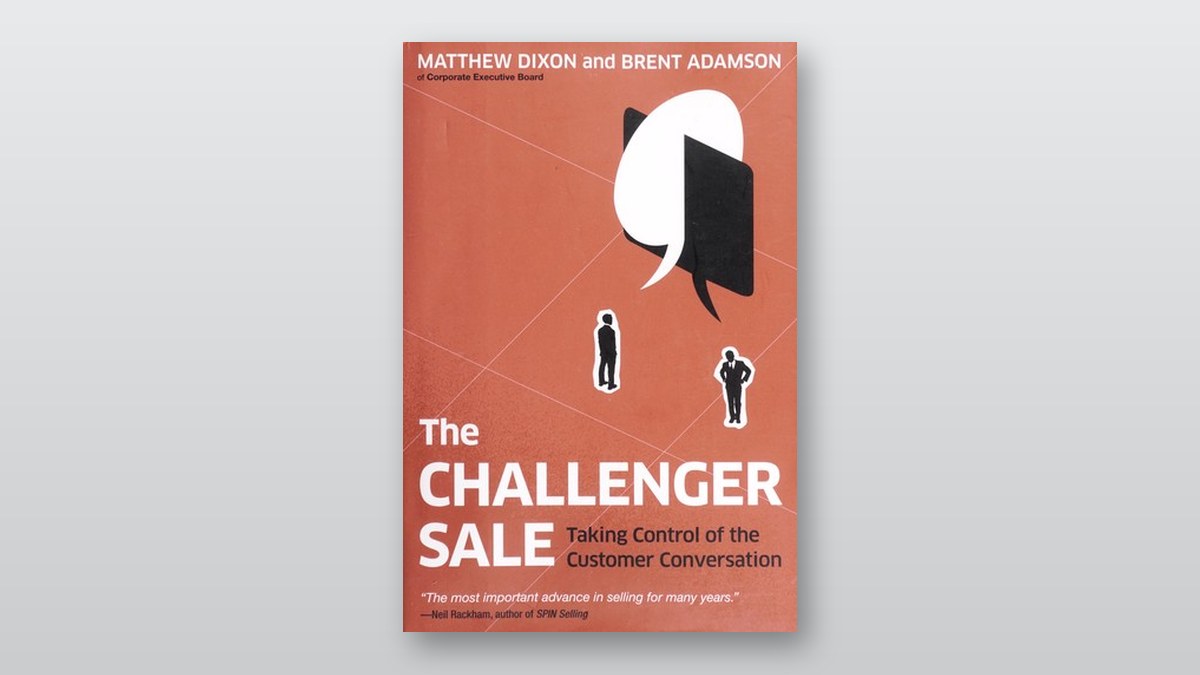
The Challenger Sale: Taking Control of the Customer Conversation is a sales book by Matthew Dixon and Brent Adamson, written with their colleagues at CEB and published by Portfolio/Penguin in 2011 (Penguin Random House). Its argument is that in complex business-to-business selling, relationship-building is a weak strategy. Of the five rep profiles the authors identify, only the Challenger delivers consistently high performance.
A Challenger teaches customers something new about their business, tailors the message to each stakeholder and is willing to take control of the sale, including pushing back. The authors say these traits can be taught to average reps.
This is a short summary in our own words, not a chapter-by-chapter retelling. It covers the profiles, the Teach-Tailor-Take Control model, commercial teaching, takeaways for sales leaders and honest limits. If you want a head-to-head with another method, see our Challenger Sale vs SPIN Selling comparison.
The five rep profiles
The book rests on a CEB study of sales rep productivity. According to The Art of Sales, every business-to-business rep in the study fit one of five statistically derived profiles.
- Challenger. Brings a distinct view of the customer's business, tailors it to the audience and is comfortable with tension. The top performer in the study.
- Relationship Builder. Focuses on being liked and on relieving tension by giving in to the customer's demands, per The Art of Sales.
- Hard Worker. Brings effort and persistence, but not the distinct insight of the Challenger.
- Lone Wolf. Works independently and by instinct.
- Problem Solver. Reliable on service and follow-up, but reactive rather than leading the conversation.
The headline numbers, as reported by The Art of Sales: Challengers are close to 40% of star reps, while Relationship Builders are only 7% of high performers. In complex solution-selling environments, Challengers rise to 54% of star reps and Relationship Builders fall to 4%.
Teach, Tailor, Take Control
The Challenger model is usually boiled down to three capabilities. The Art of Sales describes each:
- Teach. Use commercial insight and a provocative perspective instead of leading with features and benefits.
- Tailor. Adapt the message to each stakeholder's objectives and value drivers.
- Take Control. Be assertive, stay comfortable with tension and press the customer on issues such as price.
The publisher's own summary says the same thing in different words: Challengers offer unique insights about saving or making money, tailor their message to customer needs and push back when necessary (Penguin Random House).
The commercial teaching approach
Teaching is the most distinctive idea. Rather than asking customers what they need, a Challenger leads with an insight the customer had not considered, shows why it matters, and then connects it to what the company sells. The aim is to reframe the customer's thinking first.
The background, in the authors' own Harvard Business Review article, is that customers no longer need sellers the way they used to, and reps had become adept at selling solutions. The Art of Sales adds two related claims: more than 53% of what drives a business purchase decision is the salesperson's ability to teach the customer something new or challenge their thinking, and 80% of business is lost to no decision at all. We could not verify those two figures against the underlying study, so read them as claims relayed by that site.
Key takeaways for sales leaders
- Hire and coach for insight, not just rapport. The book's claim is that likeability alone is the weakest profile at the top.
- Build the teaching content first. Reps cannot teach without a sharp point of view, so marketing and sales need to produce it together.
- Coach to the stakeholder. Tailoring means different value drivers for different buyers in the same deal.
- Make pushback safe. Taking control needs managers who do not punish a rep for creating healthy tension, such as on price.
- Use it where it fits. The strongest result was in complex, large-scale deals, not simple transactional sales.
Criticisms and limits
The book was influential, but it has limits worth knowing before you rebuild a team around it.
- The data is hard to check. The profile percentages are widely repeated, but the sources we read give no methodology beyond a sample size, and that sample size is reported inconsistently.
- Fit depends on the sale. The case is built on complex business-to-business selling. The publisher frames relationship-building as weak for complex, large-scale sales, so the book does not claim to cover every kind of selling.
- Teaching needs real insight. A rep without a genuinely useful point of view can come across as arrogant rather than insightful.
- Dated context. The book came out in 2011 and its research predates today's buying committees and self-serve research habits.
The last two points are our own assessment, not findings from a cited study.
Questions people ask
Who wrote The Challenger Sale and when was it published?
Matthew Dixon and Brent Adamson wrote it with their colleagues at CEB. Portfolio/Penguin published it on November 10, 2011 as a 240-page book (Penguin Random House).
What are the five sales rep profiles?
Challenger, Relationship Builder, Hard Worker, Lone Wolf and Problem Solver. The Challenger is the highest performer in the authors' study (Wikipedia).
What does Teach, Tailor, Take Control mean?
Teach the customer something new with commercial insight, tailor the message to each stakeholder, and take control of the sale by being assertive, including on price (The Art of Sales).
What share of top performers are Challengers?
The Art of Sales reports close to 40% of star reps overall and 54% in complex solution-selling environments. That page does not publish the underlying methodology.
Is The Challenger Sale better than SPIN Selling?
They answer different questions, so see our comparison page rather than a one-line verdict.
Sources
- Penguin Random House: The Challenger Sale · Publisher, publication date, page count and book description
- Wikipedia: The Challenger Sale · Authors, CEB, publication details and the five profiles
- Harvard Business Review: The End of Solution Sales · The authors' 2012 article on why solution selling stalled
- The Art of Sales: The Challenger Sale · Profile names, reported percentages, Teach-Tailor-Take Control
- Open Library: The Challenger Sale · English edition record and cover
This summary is an independent explainer written in our own words and does not reproduce the book. Facts were read from the linked pages on October 29, 2026; percentages are as reported by the linked sources and could not be checked against the original study. Read the book for the full detail.
Top photo: Book cover via Open Library