The Effective Executive by Peter Drucker — Cliff Notes Summary
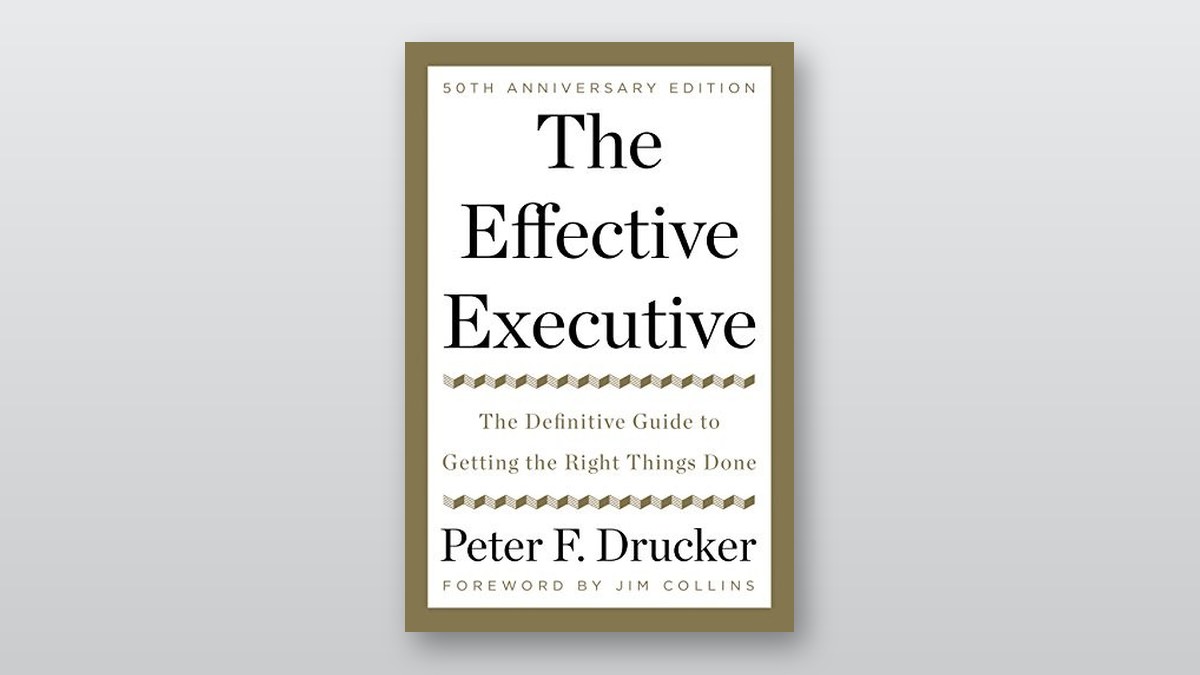
The Effective Executive by Peter F. Drucker argues that effectiveness is a learnable discipline rather than a gift, built on five practices: know where your time goes, focus on what you contribute, build on strengths, put first things first, and make decisions deliberately. Drucker's test of an executive is whether they get the right things done, which often means doing what others overlook and dropping work that should not exist, per the Google Books description. This is a summary in our own words, not a chapter-by-chapter retelling.
Open Library lists a Harper & Row first edition from 1967 at 178 pages, and its work record counts 43 editions. The edition most readers find now is the HarperBusiness release of January 24, 2017, at 240 pages, per Open Library.
The book and its editions
Drucker's book first appeared in 1967 from Harper & Row. Open Library groups 43 editions under the work, including Heinemann (1967), Pan (1970), HarperCollins (1991), HarperBusiness (1993) and a revised Collins edition in 2006. The 2017 HarperBusiness edition runs 240 pages, per Open Library, and the 2006 reprint runs 208 pages, per Google Books.
The same listings frame the book's core claim: intelligence, imagination and knowledge are wasted unless an executive has the habits of mind that turn them into results. Readingraphics puts it as effectiveness being learned by practicing a small number of simple practices until they become habit. The Shortform preview says Drucker died in 2005 and wrote 39 books.
Know where your time goes
Drucker starts with time because it is the one resource you cannot replace. Per Shortform, the first step is to record what you actually do and how long it takes, for three to four weeks at a time, twice a year, since people drift back into old habits.
Next comes pruning. The same summary says Drucker thought executives could drop roughly a quarter of their activities unnoticed, delegate what others can do, and ask colleagues which of their habits waste the colleagues' time. The last step is consolidation: discretionary time, which that summary puts at about a quarter of the total, is only useful in large unbroken blocks, per Shortform and Readingraphics.
Focus on contribution
Instead of asking what the organization owes you, ask what you can contribute. Per Readingraphics, this means taking responsibility for the organization's results, not only your own tasks. It also improves communication with subordinates and sideways with peers, and supports teamwork.
Shortform adds that the question looks past your job description to the unique contribution that could noticeably raise results, and that you should then ask your team what they intend to contribute. Meetings are worth holding only when they serve that contribution.
Make strengths productive
Results come from building on strengths, not from fixing weaknesses, per Shortform. Readingraphics describes using the strengths of superiors, peers and subordinates as the building blocks of joint performance, and structuring work so that each person's strengths are fully used and weaknesses matter less.
Practically, that means staffing and assigning around what someone does well, and not waiting for a perfectly rounded candidate.
First things first
Time, effort and resources are limited, so concentrate them, doing one thing at a time. Readingraphics gives the principle as "first things first – and second things not at all." Shortform stresses that deciding what you will not do matters as much as choosing priorities, because non-priorities creep back in.
That summary also says priorities take courage more than analysis: favor the future over the past, and opportunities over problems.
Effective decision-making
The fifth practice ties the others together. Per Readingraphics, an executive's decisions are the ones that significantly affect the organization, including controversial ones, and a decision needs courage as much as judgment. Shortform's account of the process:
- Classify the situation. Is it a typical case that an existing rule or principle can handle, or a unique one that needs fresh judgment?
- Define objectives and constraints. State what the decision must achieve and the limits it must respect, such as budget.
- Aim for the right action. Set the ideal first, before accepting compromises, rather than starting from what is acceptable.
- Plan the implementation. Without it a decision is only an intention.
- Build in feedback. Create a way to test whether the decision is working.
Lessons for sales and revenue leaders
This section is our interpretation, not a claim from the book.
- Log a month of your calendar. Count how much time goes to forecast reviews, internal meetings and real customer or coaching work, then cut the rest.
- Ask what each role contributes. Tie every rep, manager and ops person to a specific result the business can see.
- Staff to strengths. Put a rep who is brilliant at discovery on discovery-heavy accounts rather than coaching them on their weakest skill.
- Name your non-priorities. Write down the segments, deals and projects you will not chase this quarter.
- Sort decisions. Turn recurring pricing or discount calls into rules, and save your attention for the true exceptions.
Criticisms and limits
The book dates from 1967 and speaks about executives and knowledge workers in the language of that era, so some examples may feel period-bound. It also gives principles rather than step-by-step templates, and the habits it asks for, such as logging time and saying no, are simple to state and hard to keep.
Our own caution: we read publisher and library listings plus two second-hand summaries, not the full book. Read it for Drucker's own reasoning and examples.
Questions people ask
Who wrote The Effective Executive and when was it first published?
Peter F. Drucker wrote it. Open Library lists a first edition from Harper & Row in 1967 at 178 pages, and Readingraphics also gives 1967.
What are the five practices in The Effective Executive?
Managing time, choosing what to contribute, mobilizing strengths, setting the right priorities, and tying these together with effective decision-making, per the Google Books description.
Can effectiveness really be learned, according to Drucker?
Yes. The book's premise is that effectiveness is a set of practices that can be learned and repeated until they become habit, per Google Books and Readingraphics.
What does Drucker say about managing time?
Record where your time goes, remove activities that produce nothing, and consolidate what is left into large blocks, per Shortform and Readingraphics.
How should an executive make decisions in the book?
Shortform lists five steps: classify the situation, define objectives and constraints, aim for the right action, plan the implementation and build in feedback.
Which edition should I read?
Open Library shows 43 editions. The HarperBusiness edition of January 24, 2017 is 240 pages. We summarized descriptions and reviews and did not compare editions.
Sources
- Open Library: Effective Executive (work record) · 43 editions, subtitle, publishers
- Open Library: 1967 Harper & Row edition · 1967 first edition, 178 pages
- Open Library: 2017 HarperBusiness edition · January 24, 2017, 240 pages
- Google Books: The Effective Executive (2006 reprint) · Description and the five practices
- Shortform: The Effective Executive overview · Time, contribution, strengths, decision steps
- Readingraphics: The Effective Executive summary · 1967 date, habit idea, first things first
This summary is an independent explainer written in our own words and does not reproduce the book. Facts were read from the linked pages in October 2026; we did not read the full text of the book. For a related management classic, see our High Output Management summary.
Top photo: Book cover via Open Library