Topgrading by Brad Smart — Cliff Notes Summary for Sales Hiring
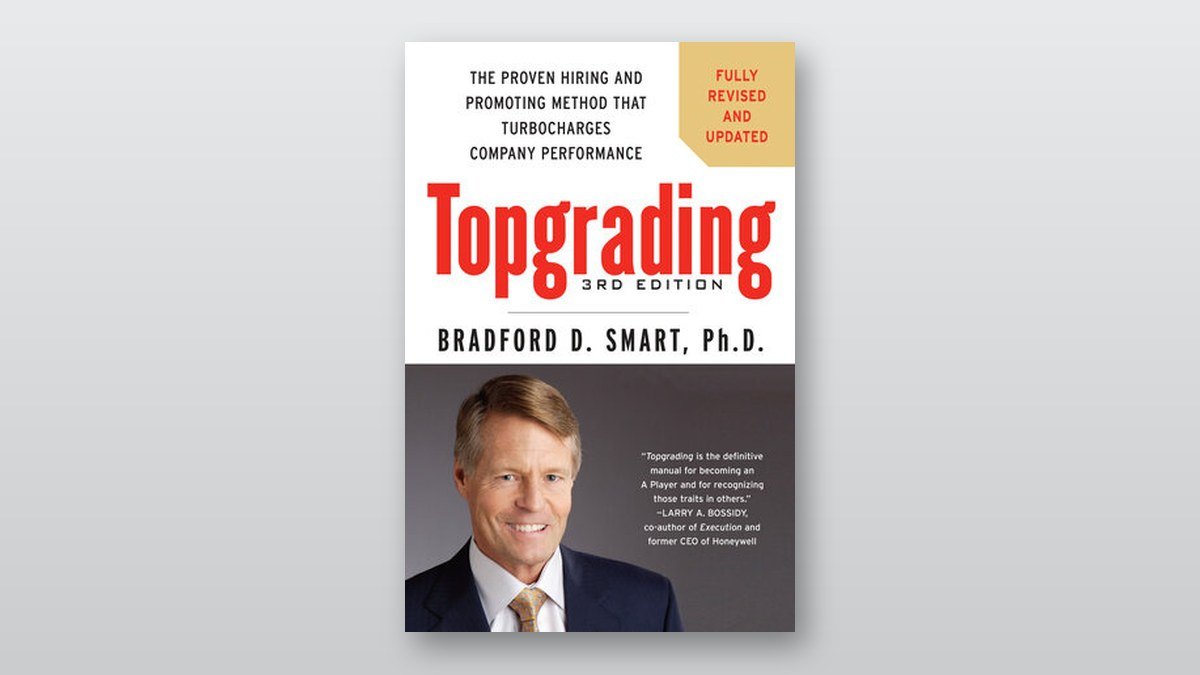
Topgrading is Bradford D. Smart's system for hiring and promoting people by evaluating a candidate's whole career instead of trusting a resume and a gut feeling. The book first appeared in 1999 (Wikipedia). This summary covers the 3rd Edition, published by Portfolio on August 16, 2012, at 352 pages in hardcover (Penguin Random House). Its core idea is to define a role with a scorecard, screen hard, run a long chronological interview and make the candidate arrange reference calls with former bosses.
There is also a separate, shorter book for our audience: *Topgrading for Sales* by Smart and Greg Alexander (Portfolio, June 19, 2008), which condenses the method for sales managers (Penguin Random House Higher Education). We cover it in its own section below, but we did not treat it as the main book. For a related idea about getting the right people in place before strategy, see our Good to Great summary.
This summary is in our own words and is built from public material: publisher pages, topgrading.com, Wikipedia and secondary write-ups, all linked below. We did not read the full text. Success rates quoted here are claims by the author, his firm or the publisher, not independently verified.
Which Topgrading book is this?
Several books carry the name, so the edition matters. The method traces to a 1997 article by Smart and his son Geoffrey, and the first book followed in 1999 under the title *Topgrading: How Leading Companies Win by Hiring, Coaching and Keeping the Best People* (Wikipedia). The publisher page for the 3rd Edition calls it the first full revision in seven years, which implies a second edition in between; we could not open a public page for that edition and do not describe it.
The 3rd Edition is priced at $32.00 in hardcover, and the publisher says it adds simplified methods for entry-level hiring, a 15-second screening tool called the Topgrading Snapshot, an updated interview script and case studies from 35 companies. A later paperback, *Topgrading (revised PHP edition)*, is listed by Penguin Random House for October 29, 2024, at 592 pages and $28.00. We did not compare it with the 3rd Edition, so treat page numbers and chapter details here as belonging to the 2012 edition only.
The topgrading.com books page also lists *Foolproof Hiring* as the seventh book in the series and *Topgrading for Sales* as the sales-manager version.
The core idea: A players and why hiring fails
The publisher says only about a quarter of new hires turn out to be high performers, and blames three things: resumes that misrepresent candidates, interviews that do not go deep enough and references that cannot be trusted. Secondary summaries define an A player as someone in the top 10% of available talent for a given role and pay level, with the goal of filling about 90% of positions with such people, against a typical company rate near 25% (Antoine Buteau; Ben Munoz).
The same notes repeat the book's claim that a mis-hire can cost about 15 times the person's base salary. That is the author's estimate as relayed by bloggers, not a figure we could check against the book.
The process in four moves
Wikipedia lists a 12-step method; the write-ups we found group it into a few moves. We have not matched them to the book's chapter order.
- Scorecard first. A job scorecard replaces the job description. It sets out the accountabilities, measurable results and competencies that define an A-level performance (Munoz).
- Screen with a career history form. Candidates complete a detailed form covering every year and month of work, plus pay and supervisor details. A screening interview of about 1 hour follows, including questions about their last 5 bosses (Munoz).
- Tandem chronological interview. The Topgrading Interview walks through the whole career job by job, ideally with two interviewers, and can run up to 4 hours. The idea is that patterns of success and failure repeat, so the history predicts the future (Wikipedia; Munoz).
- References arranged by the candidate. Candidates are told early that they must set up calls with former bosses, which the method calls the Threat of Reference Check, or TORC. The write-ups say candidates who cannot supply references do not get an offer (Munoz; Wikipedia).
Beyond hiring: coaching and redeploying
Topgrading is not only an interview. The notes describe regular talent reviews that sort current staff, a coaching focus on keeping A players, and a plan for B and C players who will not reach the standard. Munoz lists 4 redeployment styles (Hatchet, Ostrich, Topgrader, Wimp) and says the book favors the professional Topgrader approach. Buteau adds that a high-potential B player should get a development plan and be replaced if there is no improvement within six months, and that the first 90 days of onboarding matter.
What about Topgrading for Sales?
The publisher listing says *Topgrading for Sales* is by Smart and Greg Alexander, was published as an ebook on June 19, 2008, and is listed at 128 pages, although its own description says 112. It condenses the original for sales managers and directors, covering a structured interview for top sales representatives, ways to coach average performers and ways to remove underperformers before they do more damage. The same listing says the original book had sold over 150,000 copies since 1999, a publisher claim.
On topgrading.com, the sales book is promoted with the claim that Alexander moved a 12th-of-14 sales region at EMC to number one within a year. That is a promotional anecdote from the seller of the book, and we could not verify it independently.
The claimed results, and how to read them
The publisher says companies using the system have raised their hiring success rates, in some cases to around 90%. Topgrading.com says that across 52 published case studies, the share of A players hired rose from about 26% to about 85% (topgrading.com). Wikipedia cites a Georgia State University doctoral thesis (Lorence, 2014) covering six companies and about 1,000 hires, which reported the average mis-hire rate falling from 69.3% to 10.5%.
All of these come from the method's own sources, case studies selected by the firm or a single dissertation on a handful of companies. They show what adopters reported, not a controlled test, so treat them as claims.
Criticisms and cautions
Wikipedia's article says critics call the approach anti-applicant and cynical, and notes that contacting every past manager, sometimes without the candidate's knowledge, has in some cases been described as violating national law. That points to a practical caution: the method as described has the candidate arrange the reference calls, but check your own local rules and get advice before running reference checks, especially across borders.
Our own notes: the process is heavy. A multi-hour interview and a long career history form take time that high-volume hiring may not have, and most public material comes from the author's firm, the publisher or personal blogs. We have not tested the method.
What it means for sales hiring
- Write a rep scorecard. Before posting a role, list the outcomes a strong rep must deliver in the first year, such as quota attainment, and the competencies behind them.
- Interview the whole history. Walk through each sales job: what the quota was, what was achieved, why they left and how the boss would rate them.
- Check numbers with references. Ask former managers to confirm quota and results, since a resume's figures are self-reported.
- Keep your bench warm. Stay in touch with strong sellers you meet, so you are not hiring in a panic when a seat opens.
- Adapt the weight to the role. A full multi-hour process may suit a regional sales leader, while an entry-level rep may call for the lighter screening tools the 3rd Edition says it added.
Questions people ask
Who wrote Topgrading and which edition does this cover?
Bradford D. Smart, Ph.D. wrote it; the first book appeared in 1999 per Wikipedia. This page covers the 3rd Edition from Portfolio, published August 16, 2012, per the publisher page.
Is there a Topgrading book just for sales?
Yes. Topgrading for Sales, by Smart and Greg Alexander, was published by Portfolio in 2008 as a condensed version for sales managers and directors, per the publisher listing.
What is an A player in Topgrading?
Secondary summaries define an A player as someone in the top 10% of available talent for a role and pay level, as described by Antoine Buteau and Ben Munoz.
What is TORC?
The Threat of Reference Check: candidates are told up front that they will arrange calls with former bosses, which the method says discourages dishonesty. See Wikipedia.
Does Topgrading really produce 90% A players?
That is the method's goal and a claim by the author, publisher and topgrading.com, which cites about 85% across 52 case studies. We have not independently verified any success rate.
Is this summary a substitute for the book?
No. We did not read the full text. This page is written in our own words from public material, so read the book for Smart's own interview guides and examples.
Sources
- Penguin Random House, Topgrading 3rd Edition · Edition date, pages, price, publisher description and claims
- Penguin Random House, Topgrading (revised PHP edition) · 2024 paperback listing
- Penguin Random House Higher Education, Topgrading for Sales · 2008 sales edition: authors, date, pages, description
- topgrading.com · Firm's claimed case-study results
- topgrading.com books page · Book list and the sales book promotion
- Wikipedia, Topgrading · Origin, process, thesis results, criticism and legal caution
- Ben Munoz book notes · Process steps, interview structure and redeployment styles
- Antoine Buteau lessons · A player definition, 90% goal and mis-hire cost
- Book cover image · Cover of the 3rd Edition
This summary is an independent explainer written in our own words and does not reproduce the book. Facts were read from the linked pages in November 2026; check the book itself for Smart's exact method. Success rates are claims by the author, his firm or the publisher. The suggestions for sales hiring are our own.
Top photo: Book cover via Portfolio / Penguin Random House