How Big Is the Agentic AI Market and What Is the Adoption Reality in 2027?
Nobody publishes one agreed number. Published estimates for agentic AI put the market at roughly $6.76 billion to $11.56 billion in 2025, growing to somewhere between $46.04 billion by 2030 and $205.88 billion by 2033, at published growth rates of 40.2% to 49.6% a year. Those figures come from different firms measuring different things, so treat them as a range, not a fact.
Adoption is real but shallow. Surveys show most large companies trying agents, a minority running them at scale, and Gartner forecasting that over 40% of agentic AI projects will be canceled by the end of 2027. The gap between experiments and production is the story for 2027.
If you run revenue operations, the practical read is: budget for agents where a workflow is repeatable and measurable, ignore vendor claims that rebrand chatbots as agents, and do not plan around any single market-size headline.
Published market-size estimates for agentic AI
Each figure below is exactly as the firm published it. The base year, forecast year and growth rate (CAGR, compound annual growth rate) differ, which is why you cannot line them up as one trend.
- MarketsandMarkets, Enterprise Agentic AI (published July 2025)$6.76 billion in 2025 to $46.04 billion in 2030, CAGR 47%. The firm's press release rounds the 2030 figure to $40 billion.
- MarketsandMarkets, Agentic AI Market (published August 2026)Base year 2025 at $11.56 billion, forecast $205.88 billion in 2033, CAGR 40.2% for 2026 to 2033.
- Grand View Research, AI Agents Market$7.6 billion in 2025, $10.9 billion in 2026, $182.9 billion in 2033, CAGR 49.6% for 2026 to 2033. This is the narrower AI agents category.
- MarketsandMarkets, Agentic AI Sales (published November 2026)$361.9 million in 2025 to $4,871.8 million in 2032, CAGR 44% for 2026 to 2032.
Sources: MarketsandMarkets enterprise report, MarketsandMarkets agentic AI report, Grand View Research. Gartner and IDC are not quoted here because this page did not find a comparable published agentic AI market-size figure from either.
Why the estimates vary so widely
Three things explain most of the spread.
- Scope. MarketsandMarkets sizes an enterprise agentic AI market in one report and a broader agentic AI market in another. Grand View sizes AI agents. Whether a product counts as an agent is a judgment call.
- Base and forecast years. A 2030 endpoint and a 2033 endpoint cannot be compared. Even the same firm's two reports use different base figures for 2025.
- Hype in the category itself. Gartner says vendors engage in "agent washing," rebranding assistants, robotic process automation and chatbots without substantial agentic capabilities, and estimates only about 130 of the thousands of agentic AI vendors are real. Any revenue estimate that counts relabeled products will be inflated.
Market-size reports are forecasts from the research firm's own model. They are not audited revenue. Use them to judge direction, not to size your own budget.
What adoption surveys say
Surveys disagree even more than market models, mostly because they ask different people different questions. Here is who said what.
- McKinsey, State of AI 2025. An online survey fielded June 25 to July 29, 2025, with 1,993 participants in 105 nations. 23 percent said their organizations are scaling an agentic AI system somewhere in the enterprise, and another 39 percent had begun experimenting. Most of those scaling did so in only one or two functions, and nearly two-thirds had not begun scaling AI across the enterprise.
- McKinsey, State of AI 2026 (August 2026). Among organizations with $1 billion or more in revenue, 40 percent were scaling AI agents, up from 27 percent a year earlier. Smaller organizations were flat at 22 percent. These figures are from the report as summarized in trade coverage, so check the report for the sample.
- KPMG AI Quarterly Pulse, Q3 2025. 130 U.S. C-suite and business leaders at organizations with $1 billion or more in revenue. 42% had deployed at least some agents, up from 11% two quarters earlier. 82% called data quality a critical barrier.
- Deloitte, State of AI in the Enterprise 2026. 3,235 director-to-C-suite leaders in 24 countries, fielded August and September 2025. Close to three-quarters of companies plan to deploy agentic AI within two years.
- PwC AI Agent Survey, April 2025. More than 300 senior U.S. executives. 79% said their organizations are adopting AI agents, but only 35% reported broad adoption. One trade report notes that "adopting" can mean limited use inside a single application.
The reality gap: pilots versus production
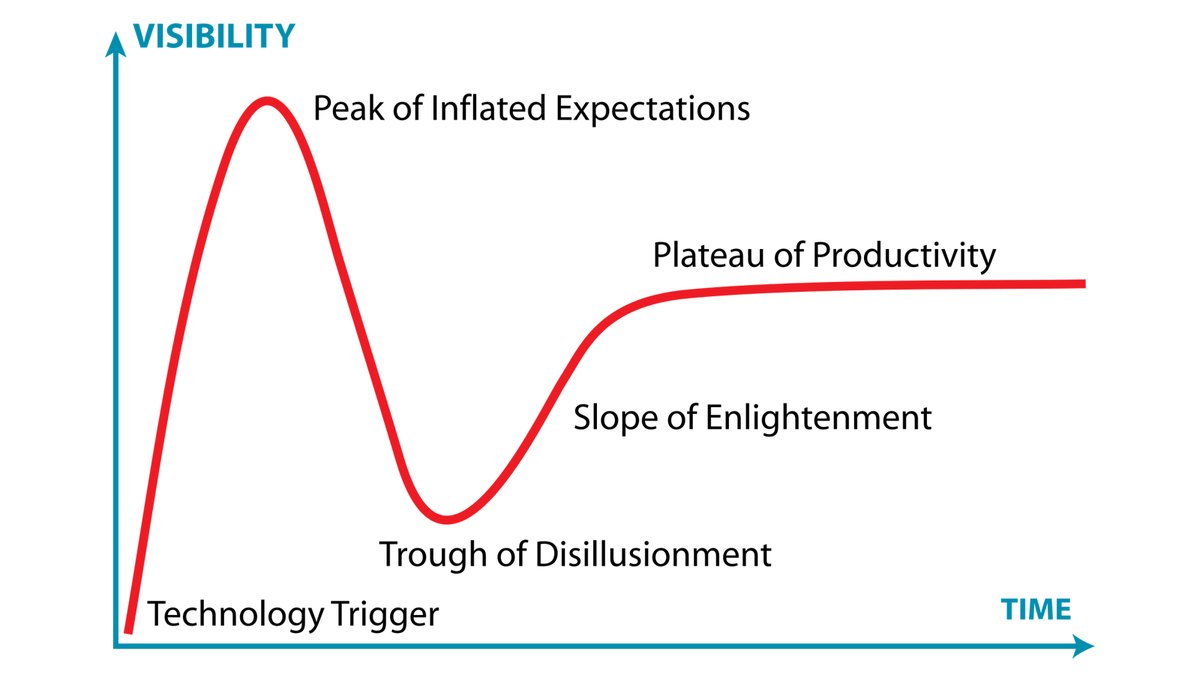
Gartner's June 25, 2025 forecast is the sharpest statement of the gap: over 40% of agentic AI projects will be canceled by the end of 2027, because of escalating costs, unclear business value or inadequate risk controls. The diagram at the top of this page is the generic Hype Cycle concept, shown only to illustrate the pattern. It does not place agentic AI on the curve.
The same release is based on a January 2025 Gartner poll of 3,412 webinar attendees. 19% said their organization had made significant investments in agentic AI, 42% conservative investments, 8% none, and 31% were waiting or unsure. Gartner analyst Anushree Verma said most projects are early-stage experiments or proofs of concept driven by hype, and that many use cases labeled agentic do not need an agentic approach.
Deloitte's survey points the same way from the buyer side. Only 25% had moved 40% or more of their AI pilots into production, and only 21% reported a mature model for agent governance. Deloitte also reports that 54% expect to reach the 40% level within three to six months, which is an expectation, not a result.
Gartner is not only a skeptic. AI Business reports Gartner predictions that a third of enterprise software applications will include agentic AI by 2028, up from less than 1% in 2024, and that at least 15% of day-to-day work decisions will be made autonomously through agentic AI by 2028, up from 0% in 2024. Both can be true: many projects fail while the surviving ones spread.
What it means for revenue teams
Sales-focused agents are a small slice of the market. MarketsandMarkets' agentic AI sales report, listed above, sizes it at $361.9 million in 2025, against the multi-billion totals for the whole category. That is one firm's estimate, but it is a useful reminder that revenue use cases are early.
- Start where the work is repeatable and measurable. KPMG's respondents say agents are taking on repeatable, measurable work, and 57% expect measurable ROI within 12 months. Lead routing, data enrichment and meeting follow-up fit that test better than open-ended deal strategy.
- Fix data first. 82% of KPMG respondents call data quality a critical barrier. An agent working from a dirty CRM will automate the mess.
- Test vendor claims. Ask whether a product plans, uses tools and acts on its own, or whether it is a rebranded assistant. Gartner's agent-washing warning applies to sales tools too.
- Plan the governance and the exit. Costs, unclear value and weak risk controls are the three reasons Gartner gives for cancellation. Write the success metric and the stop condition before you pilot.
For how agents are changing the stack itself, see how agentic AI is changing the GTM stack and RevOps. For the build-versus-buy side, see which AI agent frameworks you should know.
Questions people ask
How big is the agentic AI market?
There is no single figure. MarketsandMarkets published $6.76 billion in 2025 growing to $46.04 billion in 2030 for enterprise agentic AI, and $11.56 billion in 2025 growing to $205.88 billion by 2033 for its broader agentic AI report. Grand View Research sized the AI agents market at $7.6 billion in 2025 and $182.9 billion in 2033.
What growth rate do analysts forecast?
Published rates range from 40.2% (MarketsandMarkets, 2026 to 2033) to 47% (MarketsandMarkets enterprise report) to 49.6% (Grand View Research, 2026 to 2033). The periods and definitions differ.
Will agentic AI projects fail?
Gartner predicts over 40% of agentic AI projects will be canceled by the end of 2027, citing escalating costs, unclear business value and inadequate risk controls. That is a forecast, and Gartner also predicts wider spread of agentic AI in enterprise software by 2028.
How many companies actually use AI agents?
It depends on the survey. McKinsey found 23 percent scaling an agentic system and 39 percent experimenting in its 2025 survey. KPMG found 42% of large U.S. organizations had deployed at least some agents. PwC found 79% of surveyed executives adopting agents but 35% reporting broad adoption.
Is the 2027 adoption number published yet?
No full-year 2027 adoption or market figure is published at the time of writing. The figures above are forecasts for later years and survey results from 2025 and 2026.
Sources
- MarketsandMarkets, Enterprise Agentic AI Market · Market size to 2030 and the agentic AI sales report listing
- MarketsandMarkets, Agentic AI Market to 2033 · Market size and CAGR, August 2026
- Grand View Research, AI Agents Market · AI agents market size and CAGR
- Gartner, over 40% of agentic AI projects will be canceled by end of 2027 · Cancellation forecast, poll results and agent washing
- AI Business, Gartner 2028 agentic AI predictions · 2028 enterprise software and decision-making forecasts
- McKinsey, The state of AI in 2025 · Agent scaling and experimenting survey
- McKinsey, The state of AI in 2026: On the road to ROI · 2026 agent scaling by company size
- Deloitte, State of AI in the Enterprise 2026 · Pilot-to-production and agent governance figures
- KPMG, Q3 2025 AI Quarterly Pulse Survey · Agent deployment among large U.S. organizations
- Digital Commerce 360, PwC AI agent survey coverage · PwC April 2025 survey results
- Wikimedia Commons, Gartner Hype Cycle diagram · Hero and figure image, CC BY-SA 3.0, Jeremy Kemp
This page reports published estimates and surveys as their authors stated them, read on October 22, 2026. Check each linked report before relying on a figure, and treat all forecasts as forecasts.
Top photo: Diagram: Jeremy Kemp / CC BY-SA 3.0 via Wikimedia Commons (generic Hype Cycle concept by Gartner, not a placement of agentic AI)