How do you start an e-commerce DTC brand in 2027?
Start by picking one product you can make or buy at a known landed cost, sell at a price that leaves room for ads and shipping, and describe without making claims you cannot back up. Then set up the business (an EIN and a state entity), put a store on a platform, take cards, and run a small paid test before you buy a large first order. Most of the legwork is rules and arithmetic, not creativity.
Two dated anchors help. The Census Bureau's release of August 18, 2026 put U.S. retail e-commerce sales at $340.2 billion for the second quarter of 2026, or 17.1 percent of total retail sales (seasonally adjusted, page read November 8, 2026). And store software is cheap to start: Shopify and BigCommerce both list $29 per month entry plans when billed yearly (pages read November 8, 2026). I found no neutral published figure for how many new DTC brands survive, what a typical customer costs to acquire, or what a typical margin is, so the money sections below give formulas to fill with your own quotes instead of averages.
For what a launch plan looks like inside one category, see our guides on athleisure DTC brands and eyewear DTC brands. This page is the general starting guide.
Pick a product and test demand before you buy inventory
Direct-to-consumer (DTC) means you sell to the end buyer through your own store instead of through a retailer. The market it sits in is large: the Census Bureau's quarterly report (release dated August 18, 2026, read November 8, 2026) estimates second-quarter 2026 retail e-commerce at $340.2 billion, up 12.2 percent from the second quarter of 2025, against total retail sales up 6.7 percent over the same period. Not adjusted for season, e-commerce was $329.5 billion, or 16.4 percent of retail. The same page says the third-quarter 2026 release is scheduled for November 19, 2026, so check it for fresher numbers.
That is a market-level figure. It says nothing about any one product, and I found no published figure for how well new DTC brands do, so I do not give one. Use it only as context.
A way to choose (judgment, not a sourced finding). Score each candidate product on a short list of questions you can answer with a quote or a test:
- Can you state the landed cost? You need a supplier quote for the unit, plus freight, duty and fees to your door. If you cannot get one, you cannot price the product.
- Does the price cover ads and shipping? Work out contribution margin (below) on paper first. A product whose margin is gone after shipping and payment fees is a hobby, not a brand.
- Can you describe it truthfully? Health, safety, origin and performance claims need proof (see the labeling section). A product you can only sell with claims you cannot back is a risk.
- Do strangers want it? Test before the big order: show a landing page or pre-order to a small paid audience, or sell a small first batch, and count the buyers you reach and what each cost. Treat any single early result as a hint, not a forecast.
- Is it easy to ship? Small, light, durable items are cheaper to send and return. See the shipping section for how weight changes the price.
The category examples show the same questions in practice: the athleisure DTC guide and the eyewear DTC guide each walk through a go-to-market plan for one product type.
Sourcing and manufacturing: domestic or overseas
Import basics and de minimis. De minimis is the rule that let low-value imports enter without duty. As of the documents below, that treatment is suspended for most imports. A Federal Register interim final rule, CBP Dec. 26-13 (published June 24, 2026, read November 8, 2026), indefinitely suspends the de minimis exemption for imports valued at $800 or less arriving through the international postal network and creates a postal informal entry process, effective July 24, 2026. Its background says Executive Order 14324 (July 30, 2025) suspended the exemption under 19 U.S.C. 1321(a)(2)(C) for most imports, Executive Order 14388 (February 20, 2026) continued that suspension including for postal shipments, and the "One Big Beautiful Bill" Act enacted termination of the de minimis exemption effective July 1, 2027.
The CBP e-commerce page (last modified November 6, 2026, read November 8, 2026) links to CBP's new rules for low value shipments, says CBP extended the compliance date for new informal entry procedures for international mail from October 22, 2026 to January 20, 2027, says that when you buy goods online you become an importer, and cites nearly 4 million low-value shipments entering the U.S. each day. The plain takeaway: a brand importing goods should plan for duties and entry paperwork on every shipment, not count on duty-free treatment of small parcels. I give no duty rates. Rules change often, so check CBP's pages and ask a licensed customs broker before you order.
There is no single right answer, so compare the two on the same sheet. Here is how I would frame it (judgment, not a sourced finding):
- Domestic. Usually shorter lead times, smaller minimum orders in many cases, easier sample rounds and no import paperwork. The unit price is often higher. If you plan to say "Made in USA," the federal rule in the next section decides whether you may.
- Overseas. Often a lower unit price but longer lead times, larger minimums, freight and duty, and more cash tied up before the first sale. You usually become the importer, or hire a broker to act for you.
- Either way. Order samples first, ask for the quote in writing, keep the specification and the packaging requirements in the same document, and make a small first run so you learn the defect rate before a big one.
Duties and entry costs belong in that sheet. The number to decide on is landed cost: the unit price plus freight, duties and fees, plus inbound handling to get the goods into your fulfillment location, divided by the units you receive that are sellable. I give the formula in the unit-economics section. I could not read a published average of any of those inputs, so use your own quotes.
Business setup: EIN and sales tax
EIN. The IRS page on employer identification numbers (read November 8, 2026) says an EIN is a federal tax ID number and that you can get one for free directly from the IRS in minutes. It says you need one if you have employees and to operate a partnership, limited liability company (LLC) or corporation. If you are creating one of those legal entities, the page says to register it with your state first, then apply for the EIN. By mail it takes about 4 weeks, and by fax about 4 business days. You can use the EIN right away to open a bank account and apply for business licenses, but should wait up to 2 weeks to e-file a return or make tax deposits electronically. Only one EIN can be requested per day.
Which entity to form (sole proprietorship, LLC, corporation) is a legal and tax question for your own accountant or attorney. I did not read an official page that recommends one, so I do not.
Sales tax nexus. Since the U.S. Supreme Court's 2018 South Dakota v. Wayfair decision, a state can require a seller with no physical presence there to collect tax, as the Texas Comptroller's remote seller page (read November 8, 2026) explains. The thresholds differ by state, and I read two:
- Texas. Remote sellers with total Texas revenue of less than $500,000 in the preceding twelve calendar months are not required to get a tax permit or collect and remit state and local use tax. The Comptroller counts gross revenue from taxable and nontaxable sales. Sellers who sell only through a marketplace provider that certifies it collects the tax are not required to hold a Texas permit, but must keep marketplace sales records for at least four years.
- Virginia. The Virginia Tax page (read November 8, 2026) says a remote seller has economic nexus when it makes more than $100,000 in annual gross retail sales or 200 or more transactions to Virginia customers, and that a physical presence is not required.
The point: your obligation depends on where your buyers are, and the tests differ. A brand with many small orders can cross a transaction test before it crosses a dollar test. I did not read the other states' pages, so check each state where you ship a lot. Shopify's pricing page lists automated sales tax calculations among its features, which can help you calculate tax but does not tell you whether you owe it in a state.
Labels and claims: what the federal text says
"Made in USA." 16 CFR Part 323 says it is an unfair or deceptive practice to label a product Made in the United States unless the final assembly or processing occurs in the United States, all significant processing occurs in the United States, and all or virtually all ingredients or components are made and sourced in the United States. It covers unqualified claims such as "made," "built," "produced," "created" or "crafted" in the United States or in America, and it says a violation is treated as a violation of a rule under section 18 of the FTC Act. If your product uses imported parts, do not use the phrase on a hunch. Get the facts in writing from each supplier first.
Endorsements and influencers. 16 CFR Part 255 (the same edition) says that when a connection between an endorser and the seller might materially affect the weight or credibility of the endorsement and the audience would not expect it, the connection must be disclosed clearly and conspicuously. It says material connections can include payment or the provision of free or discounted products. If you send free product to creators, plan the disclosure into your agreement.
Other label rules (textiles, cosmetics, food, children's products, electronics, safety testing) depend on what you sell. I did not read agency pages for those, so look up the rules for your category before you print packaging.
Storefront platform pricing, as published
Both pages below were read on November 8, 2026. Prices change and promotions vary, so confirm on the platform before you commit.
- Shopify. The pricing page lists Basic at $29 per month, Grow at $79 and Advanced at $299 when billed yearly, and Plus from $2,300. Billed monthly, Basic is $39, Grow $105 and Advanced $399. It says there are no setup fees on any plan, and it advertised a trial of 3 days free and then $1 per month for 3 months.
- BigCommerce. The pricing page lists Core at $29 per month, Growth at $79 and Scale at $299, each billed annually, with Performance on custom pricing starting at $1,499 per month. Core is described as for businesses with up to $30K in annual sales and auto-upgrades to Growth. The plans are tied to online sales measured as a trailing 12-month figure using its own GMV definition (gross order value minus 10%), and the Scale plan lists 0.9% on GMV above its cap. It says there are zero fees with Embedded Payment Providers.
- Squarespace. Not read. Its pricing page returned a 403 to my request, so I give no Squarespace prices.
What to take from it (judgment): the monthly software cost is small next to ads, product and shipping. Pick on checkout, apps, support and the tax and shipping tools you need, and read the payment terms in the next section, since both pages tie fee terms to payments.
Payments and fees
Stripe. The Stripe pricing page (read November 8, 2026) lists standard pricing of 2.9% plus 30 cents per successful transaction for domestic cards, plus 0.5% for manually entered cards, plus 1.5% for international cards, plus 1% when currency conversion is needed. It says there are no setup fees or monthly fees on standard pricing. A dispute (chargeback) costs $15.00 when you receive it, and the page says a further $15.00 applies when you counter it, refunded if you win.
Shopify Payments. The Shopify pricing page (read November 8, 2026) lists online standard card rates of 2.9% + 30 cents on Basic, 2.7% on Grow, 2.5% on Advanced and 2.25% on Plus, with international cards at an extra 1%. If you use a third-party payment provider instead, it says a transaction fee of 2% on Basic, 1% on Grow, 0.6% on Advanced and 0.2% on Plus may apply.
Formula. Payment fee per order = (order total x percentage rate) + the fixed fee, and a refund or chargeback adds its own cost. Put the fee in your margin model as a percentage plus a fixed amount, because the fixed part weighs more on a small order. I did not read the card networks' own fee schedules, so I give no estimate beyond the processor pages.
Shipping: what the carriers publish
The USPS Price List, Notice 123 (effective October 4, 2026, read November 8, 2026) lists USPS Ground Advantage prices by weight and zone. In the retail table, a 1 lb parcel runs from $10.05 in the first price column to $13.65 in the last, and a 4 oz parcel from $8.40 to $10.20. In the commercial table, a 1 lb parcel runs from $8.01 to $11.22 and a 4 oz parcel from $7.33 to $8.95. The point is that weight and distance move the price, and commercial pricing is lower than retail. Read the table's own zone headings for your lanes.
Shopify says it offers shipping discounts of up to 87% off and lets you buy and print labels in the store, according to its pricing page (read November 8, 2026). BigCommerce says it shows real-time carrier quotes. Whether a discount applies to your parcels depends on the plan and the carrier, so test a few real orders.
The formula: shipping cost per order = postage for the weight and zone + packaging + labor to pick and pack. Decide early whether you charge shipping, build it into the price, or offer free shipping above a cart value, and model returns, because a return costs you a second shipment.
Fulfillment options
I did not read a third-party logistics (3PL) or marketplace-fulfillment price list, so this section gives the options and the trade-offs, not prices (judgment, not a sourced finding):
- You pack at home or in a small space. Cheapest to start, full control of the unboxing. It stops working when orders outgrow your time.
- A 3PL. A warehouse stores your stock and ships orders. Ask for the full fee list: receiving, storage, pick and pack, packaging and returns, and for the minimums.
- Dropshipping or print-on-demand. A supplier ships on your behalf, so you hold no stock, but you give up some control of quality, speed and margin. Shopify's pricing page mentions Shopify Collective for selling and sourcing products, which is one example of such a link. I did not verify how it works beyond that mention.
- Marketplaces. Selling through a marketplace adds reach and often handles tax collection, as the Texas page describes for marketplace providers, but you share the customer relationship.
Whichever you pick, order a test shipment to your own address, and time how long the first real order takes from click to door.
Unit economics, as formulas
- COGS (cost of goods sold). COGS per unit = the unit price from your manufacturer plus any per-unit materials and finishing. It is what you pay for the product itself, before freight and fees.
- Landed cost. Landed cost per unit = (unit price x units + freight + duties and customs fees + inbound handling) divided by sellable units received. Rejected or damaged units raise it.
- Contribution margin per order. Contribution margin = order revenue - (landed cost of the items + payment fees + outbound shipping + packaging + pick and pack + expected returns and chargebacks). Take sales tax out of revenue first, since you collect it for the state.
- Contribution margin percent. Contribution margin percent = contribution margin divided by order revenue.
- CAC (customer acquisition cost). CAC = marketing and sales spend in a period divided by the new customers it brought in. Count the ad spend, the creator fees and the free product you send.
- CAC payback. CAC payback (in orders) = CAC divided by contribution margin per order. In months, divide CAC by the contribution margin you earn from a customer in a month. If the number is longer than you can fund, the model needs a higher price, a lower cost or repeat purchases.
- Break-even. Break-even orders = fixed monthly costs (software, salaries, rent) divided by contribution margin per order.
Put the platform and payment fees from the sections above into the contribution margin line, as a percentage and a fixed amount. If contribution margin is negative on the first order and you depend on repeat buying to recover, say so explicitly in your plan and test whether repeat buying happens.
Marketing channels
No published benchmark for what each channel costs a new brand was found, so I list channels and what each needs to work (judgment, not a sourced finding):
- Paid social and search ads. Fast to test, and your CAC shows up within days. They need a clear offer, a landing page that loads quickly and a way to measure which ad produced which sale.
- Email and SMS. Cheap per message once you have a list. Shopify's pricing page lists email campaigns, pay-per-send SMS campaigns and abandoned checkout recovery as features. Check the rules for consent in your state before sending texts.
- Creators and affiliates. Send product or pay a fee, and tell the audience about the relationship, since the federal endorsement guides treat free product and payment as material connections that must be disclosed.
- Organic content and search. Slow to build but not billed per click. Publish what a buyer needs to decide: sizes, materials, care and honest comparisons.
- Marketplaces and retail partners. Reach buyers who already shop there, at the price of fees and less control. Shopify's pricing page lists selling on social and marketplaces among its features.
Run one channel at a time at small scale, log CAC and payback for each, and add a second only after the first is measurable.
A launch plan in eight steps (judgment, not data)
- Choose the product. Write down its target price, a supplier quote and the claims you can back up.
- Model the margin. Fill landed cost, payment fees, shipping and returns into contribution margin before you spend.
- Form the entity and get the EIN. State registration first, then the free IRS application.
- Check sales tax. List the states where you expect many buyers and read each revenue department's threshold.
- Open the store. Pick the platform, set up payments, taxes and shipping, and place a test order.
- Order samples, then a small first run. Check quality and the labels, and do not use "Made in USA" without proof.
- Run a paid test. One channel, small budget, track CAC.
- Decide from the numbers. If CAC payback fits your cash, scale the channel. If not, change the offer, the price or the cost first.
Questions people ask
How much does it cost to start a DTC brand?
No neutral published startup figure was found. Platform fees are published: Shopify and BigCommerce each list $29 per month on entry plans billed yearly (read November 8, 2026). The larger costs, such as inventory, samples, ads and shipping, depend on your product and quotes.
Do I need an EIN?
The IRS says you need one if you have employees and to operate a partnership, LLC or corporation, and that you can get one for free directly from the IRS in minutes. A sole proprietor without employees should check the IRS page and ask an accountant.
When do I have to collect sales tax in another state?
It depends on the state. Texas says remote sellers with less than $500,000 in Texas revenue over the preceding twelve calendar months are not required to get a permit, while Virginia says economic nexus starts above $100,000 in gross retail sales or 200 or more transactions. Check each state where you ship.
Can I say my product is Made in USA?
Under 16 CFR 323 (govinfo.gov edition dated January 1, 2024), an unqualified claim requires final assembly or processing in the United States, all significant processing in the United States and all or virtually all components made and sourced in the United States. Confirm the current text before using it.
How much does payment processing cost?
Stripe lists 2.9% + 30 cents per successful domestic card transaction, with extra for international and manually entered cards. Shopify Payments lists 2.9% + 30 cents online on Basic, falling to 2.25% on Plus (pages read November 8, 2026).
How do I figure out whether the business can make money?
Compute contribution margin per order (revenue less landed cost, payment fees, shipping, packaging, pick and pack and returns), then divide CAC by it to get CAC payback in orders. Both formulas are above.
What share of retail sales is e-commerce?
The Census Bureau estimated 17.1 percent for the second quarter of 2026, seasonally adjusted, in its release of August 18, 2026. The third-quarter release is scheduled for November 19, 2026.
What about import duties and de minimis?
A Federal Register rule (CBP Dec. 26-13, published June 24, 2026) indefinitely suspends the de minimis exemption for imports of $800 or less arriving by international mail, effective July 24, 2026, and its background says the suspension covers most imports, with the statutory exemption set to end July 1, 2027. Plan for duties and entry paperwork, and ask a licensed customs broker.
Sources
- U.S. Census Bureau: Quarterly Retail E-Commerce Sales, release of August 18, 2026 (read November 8, 2026) · Q2 2026 e-commerce sales and share of retail; next release date
- IRS: Employer identification number (read November 8, 2026) · Who needs an EIN, how to apply, timing
- Texas Comptroller: Remote Sellers (read November 8, 2026) · Economic nexus and the $500,000 safe harbor
- Virginia Tax: Remote Sellers, Marketplace Facilitators, and Economic Nexus (read November 8, 2026) · Economic nexus threshold of $100,000 or 200 transactions
- 16 CFR Part 323: Made in USA Labeling (govinfo.gov, edition dated January 1, 2024) · Federal text of the Made in USA standard
- 16 CFR Part 255: Endorsement Guides (govinfo.gov, edition dated January 1, 2024) · Disclosure of material connections
- CBP: E-Commerce (last modified November 6, 2026; read November 8, 2026) · Importer status, low-value shipment rules, compliance date extension
- Federal Register 2026-12669, CBP Dec. 26-13 (published June 24, 2026) · Indefinite suspension of de minimis for mail shipments; postal informal entry
- Shopify: Pricing (read November 8, 2026) · Plan prices, Shopify Payments rates, third-party fees, features
- BigCommerce: Pricing (read November 8, 2026) · Plan prices and payment-fee terms
- Stripe: Pricing (read November 8, 2026) · Card processing and dispute fees
- USPS: Price List Notice 123, effective October 4, 2026 (read November 8, 2026) · USPS Ground Advantage retail and commercial parcel prices
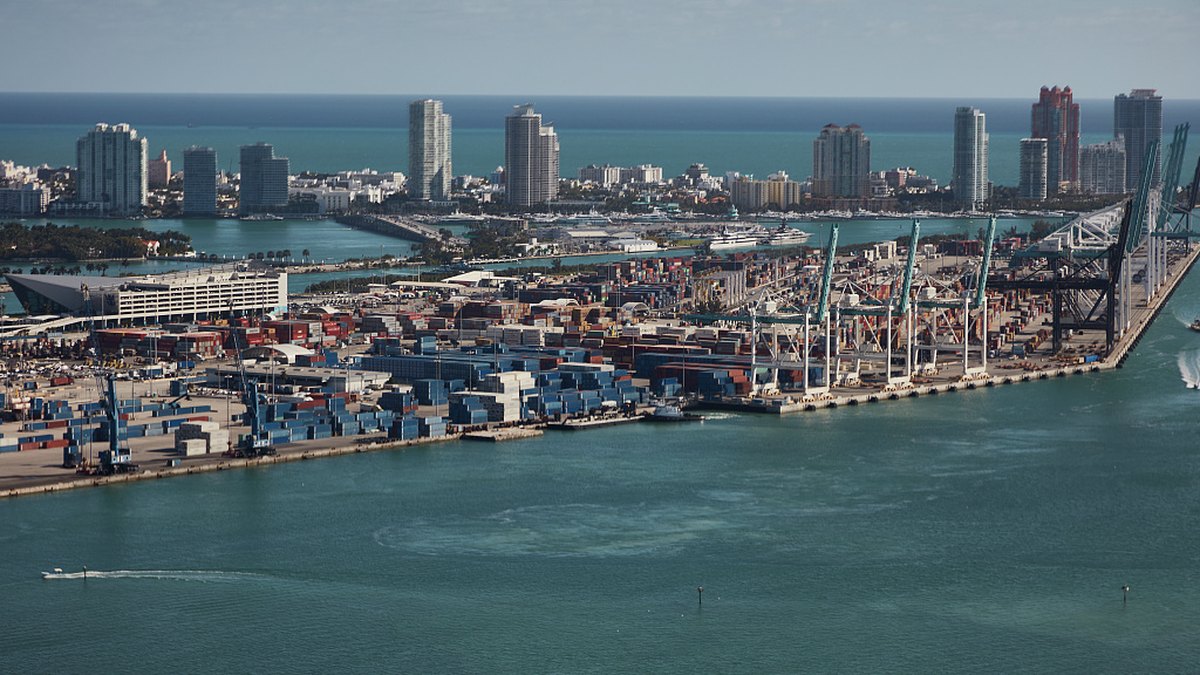
- Hero photo: Carol M. Highsmith, Library of Congress (2020; no known restrictions on publication) · Aerial view of the shipping-container port in Miami, Florida
Figures were read from the linked pages on November 8, 2026 and each carries its date. Gaps: no duty rates are given, Squarespace pricing (403), UPS rates (Access Denied), FedEx rates (Not Found), and the FTC web pages (Not Found, so the labeling and endorsement rules come from the January 1, 2024 federal regulation text). I read sales tax rules for only two states, Texas and Virginia. I found no neutral startup-cost, margin, customer-acquisition-cost, return-rate or fulfillment-price figure and invented none. This is a business guide, not legal, tax or financial advice.