How do you start an online ESL tutoring business in 2027?
Start by choosing where your students will find you, because that choice sets your pricing, your paperwork and how much of each lesson you keep. You can list on a marketplace that supplies students and takes a commission, or you can run your own brand and pay for your own marketing and payments. Then pick a first niche (adults or kids, conversation or exam prep), set a price with a formula instead of a guess, and handle the US basics: self-employment tax and, if you teach children, privacy rules.
The published numbers show the trade-off. Preply says its commission on a trial lesson with a new student is 100%, then starts at 33% and falls to 18% with hours taught (page read November 8, 2026). Cambly's tutor page lists $10.2 per hour on Cambly and $12 per hour on Cambly Kids (read November 8, 2026), set by Cambly. On your own, Stripe lists 2.9% + 30¢ per successful domestic card transaction (read November 8, 2026), but you must find every student yourself. I found no neutral market-size or earnings statistic for online ESL tutoring and invented none, so the pricing section gives formulas to fill with your own quotes.
Pick the model first
There are four choices to make, and each one changes the business. They are not exclusive, but your first month is easier if you pick one side of each.
- Marketplace or your own brand. A marketplace gives you students and a classroom and takes a cut. Preply's commission page (read November 8, 2026) says it is free to sign up and that commission is charged only once you get bookings. Your own brand keeps the whole price, but you pay for payments and you earn nothing until you have found students. A common path is to start on a marketplace to learn what students ask for, then move regulars to your own brand. Check each platform's rules first, because italki's teacher policy (effective January 30, 2026; read November 8, 2026) forbids soliciting or accepting payment outside its platform.
- One-to-one or small group. Both Preply and Cambly describe one-to-one lessons; Cambly's page says students build their English in 1-on-1 lessons. I found no published group-class pricing or fill-rate figure for ESL, so I give none. Groups raise revenue per hour only if seats fill, which is a formula you test (see the pricing section).
- Adults or children. Cambly lists a separate Cambly Kids rate of $12 per hour against $10.2 per hour on Cambly (page read November 8, 2026), so even a marketplace treats them as different products. Teaching anyone under 13 also brings privacy rules covered below. Many new tutors start with adults for that reason; that is my judgment, not a sourced finding.
- Exam prep or conversation. Exam prep sells a defined outcome. The IELTS test types page (read November 8, 2026) says the Speaking and Listening sections are the same in the Academic and General Training tests, and that Academic suits people planning to study where English is spoken. The TOEFL iBT page (read November 8, 2026) says the test measures reading, listening, speaking and writing, and can be taken in a test center or at home. Conversation lessons are easier to start but harder to tell apart from the next tutor. Learn the exact test format from the test owner before you promise results.
My judgment, not a sourced finding: choose one marketplace, one student group and one lesson type for your first quarter. A narrow offer is easier to describe in a profile and easier to price.
Credentials: TEFL, TESOL, CELTA
What the labels mean. The TESOL International Association FAQ says TESOL is a general name for the field that includes teaching English as a second language (TESL) and as a foreign language (TEFL). It warns that not every TESOL certificate program is offered by TESOL International Association, that certificate programs provide an introduction to teaching, and that the association does not evaluate teacher education programs. It also says that, generally speaking, the minimum qualification to teach in private language schools around the world is a bachelor's degree and some type of TESOL certificate.
CELTA. Cambridge English describes CELTA as a qualification for teaching English as a foreign language, with at least 120 hours of study, teaching practice with groups of learners face-to-face or online, and more than 280 centres worldwide. Cambridge says over 63% of English language teaching jobs require CELTA, citing 200 job adverts in over 40 countries from January to September 2025. That is Cambridge's own claim about its own product, so read it with that in mind. It also says you can begin teaching in as little as four weeks.
CertTESOL. Trinity College London lists its CertTESOL as Level 5 on the Ofqual framework, with 200 hours of total qualification time, a minimum of 130 guided learning hours and at least six hours of teaching practice with real learners. Formats include full-time, part-time, online or blended.
Do you need one to start? Not to list on every platform. Preply's teach page says no specific certification or teaching experience is required, and Cambly's tutor page says no teaching certificate, bachelor's degree or prior experience is needed (both read November 8, 2026). Those are the platforms' own entry rules; students may still choose the tutor with a certificate, and a credential can matter more when you sell on your own brand, where nobody has vetted you. Check the rules of whichever platform you choose, since requirements differ by platform and I could not read italki's help pages.
Platform rules and commission terms, as published
- Preply (commission page read November 8, 2026; page dated September 19, 2024). Commission on every trial lesson with a new student is 100%. For later lessons it is between 18% and 33% of the hourly rate, depending on total hours taught; it starts at 33% and, after 20 hours, goes down to 28%, and so on. Trial lessons count toward the hours. Preply's own example: at an hourly rate of 10 USD, a new tutor receives 6.70 USD per non-trial lesson and a tutor with 400+ hours receives 8.20 USD. The teach page says profiles are reviewed within 3 business days, asks for a short video up to 2 mins long, and tells tutors to avoid contact details and lesson prices in the profile and video.
- italki (teacher policy effective January 30, 2026; read November 8, 2026). The policy says italki charges Platform Service Fees after the student confirms a lesson is complete, and that fees may vary based on the type of lesson, the number of lessons in a package and the teacher's overall performance. It says teachers must not circumvent the fees, including by accepting payment outside the platform, and must not post personal contact information. I could not read the percentage. The policy points to a help-center article, and support.italki.com returned 403 to my request, so I stopped using that host and give no italki rate.
- Cambly (tutor page read November 8, 2026). The page lists $0.17 per minute ($10.2 per hour) on Cambly and $0.20 per minute ($12 per hour) on Cambly Kids, weekly pay via direct deposit, and no minimum hours. It also says Cambly is temporarily limiting the number of new tutors it welcomes, so you may face a wait. Cambly sets the rate; you do not. I could not read Cambly's support center (support.cambly.com returned 403), so I give no payout minimums or tax terms from it.
What this means for a business plan (judgment): on a marketplace you are an independent seller inside someone else's rules. Read for three things: who sets the price, what the platform keeps, and what you may do with students you meet there. Keep a copy of the terms you accepted, with the date.
Pricing math, as formulas
- Marketplace take-home. Take-home per lesson = your listed hourly rate x (100% minus the platform's commission rate). Preply's own example fits this: a 10 USD rate at a 33% commission leaves 6.70 USD, and at 18% leaves 8.20 USD. Trial lessons pay you nothing on Preply, so treat each trial as a marketing cost and count how many convert.
- Own-brand take-home. Net per lesson = price you charge minus the card fee. Stripe's pricing page (read November 8, 2026) lists 2.9% + 30¢ per successful transaction for domestic cards, plus 1.5% for international cards and 1% if currency conversion is required. So fee = (price x 2.9%) + 30¢ for a domestic card. Students abroad are common in ESL, so model the international surcharges too.
- Cost to win a student. Acquisition cost per student = (marketing spend + unpaid trial time valued at your rate) divided by new students won. Compare it with lifetime value below.
- Lifetime value. Lifetime value = lessons per student per month x months a student stays x net per lesson. The number that decides your business is months retained, which you will only learn from your own records. The tutoring KPIs page on this site covers retention and utilization for tutoring centers; use it as a checklist for what to measure, not as a benchmark for a solo tutor.
- Utilization. Utilization = paid lesson hours divided by hours you make available. Add unpaid time: prep, messages, scheduling, and lesson notes. Your true hourly pay = total net income divided by all hours worked, not only teaching hours.
- Group classes. Revenue per group hour = seats filled x price per seat. Break-even seats = your target revenue per hour divided by the price per seat. If you would not fill that many seats on a normal week, a group is a worse deal than one-to-one.
- Package pricing. Price per lesson in a package = package price divided by lessons included. Compare it with your single-lesson price to see the discount, and remember that italki's policy says fees can vary with the number of lessons in a package.
A sanity check on your own numbers: set the rate so that take-home after commission or card fees, after your own taxes (next section), still pays for the hours you work. Raise it as your hours and reviews grow, since on Preply the commission itself falls as hours rise.
Payments and taxes for a US-based solo business
Self-employment tax. The IRS self-employment tax page (last reviewed or updated October 30, 2026; read November 8, 2026) says the rate is 15.3%, made up of 12.4% for social security and 2.9% for Medicare. For 2026 it says the first $184,500 of combined wages, tips and net earnings is subject to the social security part. You must pay it and file Schedule SE if net earnings from self-employment were $400 or more, and a sole proprietor or independent contractor generally uses Schedule C to figure those net earnings. The page says you can deduct the employer-equivalent portion of the tax when figuring adjusted gross income, and that an additional 0.9% Medicare Tax applies above threshold amounts.
Estimated tax. The IRS estimated taxes page (last reviewed or updated September 25, 2026; read November 8, 2026) says sole proprietors generally have to make estimated payments if they expect to owe $1,000 or more when their return is filed, and that most taxpayers avoid the penalty if they paid at least 90% of this year's tax or 100% of last year's tax, whichever is smaller. Form 1040-ES is used to figure it. The formula to plan with: set aside = net profit x (self-employment rate + your income tax rate), then pay it in installments. Your income tax rate is your own, so I give none.
Payments. Marketplaces pay you out themselves (Preply's teach page lists Paypal, Payoneer, Skrill or Transferwise; Cambly lists weekly direct deposit), and withdrawal fees may come from the third party, as italki's policy notes. On your own brand you pick a processor; Stripe's fee is given above. Keep business money in a separate account (judgment) so the tax math is clean.
Setting up. I found no readable official source for state or local business licenses and registration in this pass, so give none. Check your state and city, and ask whether an online-only tutor needs a license, a business name registration or a sales tax registration where you live.
Teaching children: safety and privacy basics
The rule text, 16 CFR part 312 defines a child as an individual under the age of 13. Its definition of personal information includes a name, an address, online contact information, a phone number, a persistent identifier such as an IP address, and a photograph, video or audio file that contains a child's image or voice. That matters for tutors, because a recorded lesson with a young learner can fall in that group.
The rule says it is unlawful for an operator of a site or online service directed to children, or an operator with actual knowledge that it is collecting personal information from a child, to collect it in violation of the rule. In general an operator must:
- Give notice. Say what information you collect from children, how you use it and what you disclose.
- Get verifiable parental consent. Before any collection, use or disclosure of the child's personal information.
- Let parents review. Give a reasonable way for a parent to review what was collected and refuse further use.
- Collect only what is needed. Do not make a child share more personal information than is reasonably necessary.
- Protect it. Keep reasonable procedures for confidentiality, security and integrity.
Whether your small business is an "operator" under the rule depends on how you collect and store information, which I cannot decide for you. Practical habits (judgment): talk to the parent first, not the child; keep a parent in the room or the lesson link; do not record lessons without written parent consent; keep student contact details in one secure place; and read the platform's own child rules before you accept young learners.
Tools
Start with the minimum that the platform names. Preply's teach page (read November 8, 2026) says you need a laptop or desktop computer, a stable internet connection, a webcam and a microphone, and its commission page says Preply Classroom is a secure video tool for lessons with materials currently available for English subject tutors. So a marketplace can supply the classroom, and your costs are mostly your equipment and your time.
If you go on your own, you need four things (judgment, no price claims): a video lesson tool, a way to take bookings and send reminders, a payment processor (Stripe's published fee is above), and a place to keep lesson notes and parent consent forms. I tried to read Zoom's pricing page, but it returned no prices to my request, so I list no video-tool prices. Compare current plans yourself, and check each tool's rules about recording and children before you use it.
Marketing
On a marketplace, your profile is your storefront. Preply asks for a short video up to 2 mins long and tells tutors to leave contact details and lesson prices out of the profile and video, and italki's policy bars personal contact information and advertising third-party platforms. Follow those rules, or Preply says approval will be slower.
For your own brand (judgment, not data): write one sentence that names the student and the result, such as who you teach and what they can do after ten lessons. Publish a free sample lesson or a short intro video, ask each happy student for a review you can show, and put your rates and cancellation rules on your site. Track where each student came from so you can compare channels with the acquisition formula above. Do not claim results, scores or credentials you cannot show, and if you teach for an exam, name the test owner's own format and not a guarantee.
A working plan in six steps (judgment, not data)
- Choose the model. Marketplace or own brand, one-to-one or group, adults or kids, exam prep or conversation.
- Check your credential. Decide whether you need a TESOL-type certificate for the students you want, and read what the certifying body says it covers.
- Read the platform terms. Save the commission and conduct rules with the date, and note anything you could not read.
- Price with the formulas. Take-home, acquisition cost, lifetime value and utilization, filled with your own numbers.
- Set up money and tax. A separate account, a set-aside for self-employment and income tax, and a plan for estimated payments.
- Add child safeguards before the first young student. Parent contact, consent, recording rules and secure storage.
Questions people ask
Do I need a TEFL, TESOL or CELTA to teach English online?
Not to list on Preply or Cambly: Preply says no specific certification or teaching experience is required, and Cambly says no teaching certificate is needed (both pages read November 8, 2026). A certificate can still help you win students, and Cambridge says CELTA includes at least 120 hours of study.
How much commission do online tutoring platforms take?
Preply says 100% of a trial lesson with a new student, then between 18% and 33% of the hourly rate depending on hours taught (read November 8, 2026). Cambly sets a fixed tutor rate of $10.2 per hour on Cambly and $12 on Cambly Kids. italki says its fees vary but I could not read the percentage.
Should I start on a marketplace or build my own brand?
A marketplace supplies students and a classroom for a commission; your own brand keeps the full price but you pay card fees (Stripe lists 2.9% + 30¢ per domestic card transaction) and find every student yourself. Many tutors start on a marketplace, but check each platform's rules before moving students off it.
What taxes does a US solo tutor pay?
The IRS says the self-employment tax rate is 15.3% (12.4% social security and 2.9% Medicare), due if net earnings from self-employment were $400 or more, and sole proprietors generally make estimated payments if they expect to owe $1,000 or more. This is general information, not tax advice.
What privacy rules apply when I teach children?
The federal COPPA rule treats anyone under 13 as a child and lists a photo, video or audio file containing a child's image or voice as personal information. It requires verifiable parental consent in covered cases. Ask a lawyer whether it applies to your business.
How much does it cost to start?
No neutral startup-cost figure was found. On a marketplace the platform lists a laptop or desktop, a stable connection, a webcam and a microphone as the equipment; add any course fee, tax set-aside and marketing you plan.
Sources
- Preply Help Center: Preply commission model (page dated September 19, 2024; read November 8, 2026) · Trial and later-lesson commission; 10 USD example
- Preply: Teach on Preply (read November 8, 2026) · No certification required, profile rules, equipment, payout methods
- italki: Teacher Policy (effective January 30, 2026; read November 8, 2026) · Fees vary; no off-platform payment; no contact details
- Cambly: Become a tutor (read November 8, 2026) · Per-minute and per-hour tutor rates; sign-up limit
- Cambridge English: CELTA (read November 8, 2026) · Hours, centres, online option, job-advert claim
- Trinity College London: CertTESOL (read November 8, 2026) · Level, hours, teaching practice, formats
- TESOL International Association: FAQ about starting a career in TESOL (read November 8, 2026) · What TESOL and TEFL mean; certificate caveats
- IELTS: Test types (read November 8, 2026) · Academic and General Training
- ETS: TOEFL iBT (read November 8, 2026) · Four skills; test center or at home
- IRS: Self-employment tax (last reviewed or updated October 30, 2026; read November 8, 2026) · Rate, wage base, Schedule SE and Schedule C
- IRS: Estimated taxes (last reviewed or updated September 25, 2026; read November 8, 2026) · Who must pay, safe harbor, Form 1040-ES
- Stripe: Pricing (read November 8, 2026) · Card processing fees
- US Government Publishing Office: 16 CFR part 312, 2024 edition (read November 8, 2026) · COPPA rule text
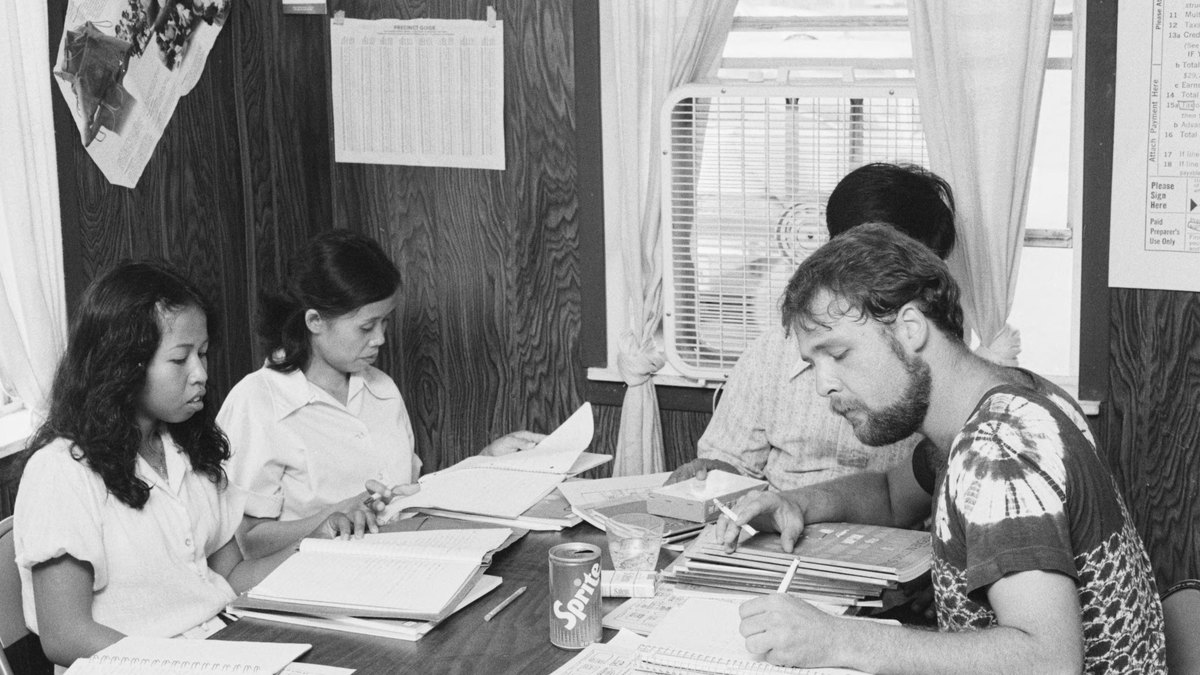
- Hero photo: Frank Proschan, Library of Congress American Folklife Center (1982; fieldwork in the collection is in the public domain per the Library) · Adult ESL class, Khmer Village, Houston, Texas
Figures were read from the linked pages on November 8, 2026 and each carries the date shown beside it. Gaps: italki's fee percentage (support.italki.com returned 403), Cambly's support center (403) and the SBA business guide (403) were not read; ftc.gov returned Not Found pages to four requests, so COPPA comes from the 2024 federal rule text; Zoom's page returned no prices. I found no neutral earnings, market-size or startup-cost statistic for online ESL tutoring and invented none. This is a business guide, not legal, tax or financial advice.