Give and Take by Adam Grant — Cliff Notes Summary
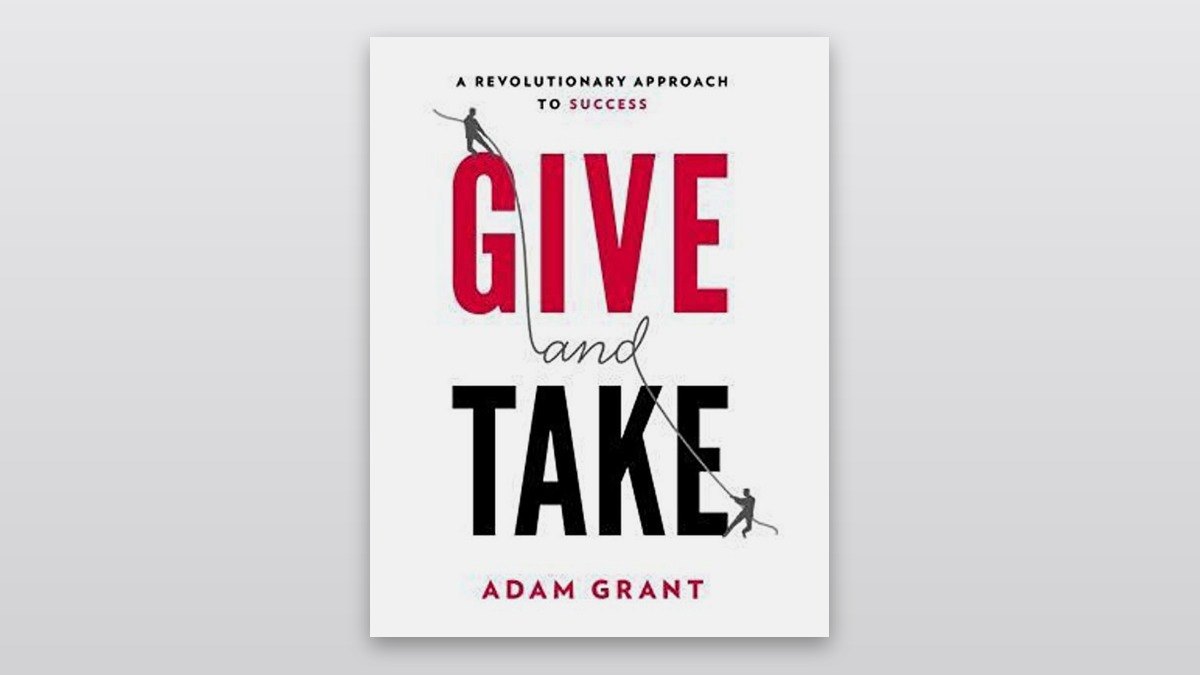
Give and Take: A Revolutionary Approach to Success is Adam Grant's argument that how you deal with other people at work matters as much to your success as talent, effort and luck. He sorts people into three styles: takers, who try to get more than they give; matchers, who trade evenly; and givers, who share their time, knowledge and connections without keeping score. His surprising claim is that givers fill both the bottom and the top of the success ladder, and that what separates the two groups is how they give, not whether they do.
The edition in the Library of Congress catalog is from Viking, New York, copyright 2013, at 305 pages (Library of Congress). This summary is in our own words and uses the author's own site, including his free Chapter 1 excerpt, and the library record, all linked below. We did not read the full book, so it covers the core ideas, not every chapter or story.
The book at a glance
- BookGive and Take: A Revolutionary Approach to Success, by Adam M. Grant, per the Library of Congress record.
- Publisher and yearViking (New York), copyright 2013, 305 pages, per the Library of Congress.
- Core ideaMost people at work are takers, matchers or givers, and the style shapes success, per Adam Grant's book page.
The publisher's own page refused our request, so we could not use it, and the library record gives no ISBN. Check the edition you buy, since later paperbacks may differ in page count.
The author
Grant is an organizational psychologist. His own bio says he has been Wharton's top-rated professor for 7 straight years, holds a Ph.D. in organizational psychology from the University of Michigan and a B.A. from Harvard, and co-directs Wharton People Analytics. It adds that his research has increased performance and reduced burnout among engineers, teachers and salespeople. We could not reach Wharton's faculty page, so these facts come from his site alone.
His book page describes Give and Take as a New York Times and Wall Street Journal bestseller. That is the author's own statement; we did not check it elsewhere.
The core idea: three ways of dealing with people
Per the Chapter 1 excerpt on Grant's site, the three styles differ in how people weigh their own interests against other people's.
- Takers are self-focused and help others when the benefit to themselves outweighs the cost. Grant says most are not cruel, just self-protective.
- Matchers aim for an even trade: favor for favor.
- Givers are other-focused and help when the benefit to others exceeds the cost to them, or without counting the cost at all. They are the rare group.
Grant says these styles are not about money or charity donations. They describe attitudes and actions toward other people. He also says most people settle on a main style at work, even if they act differently with certain people.
The surprise: givers are at both the bottom and the top
Most readers would guess that takers win. The excerpt argues otherwise, using Grant's own data and studies he cites. In the bottom group he places givers: among more than 160 California engineers, the least productive were givers, and among more than 600 Belgian medical students, the lowest grades went to students with strong giver traits. In a study of North Carolina salespeople led by Grant, givers brought in roughly two and a half times less annual revenue than takers and matchers, because they held back from selling hard.
The same data shows givers at the top as well. The best engineers, the highest-grade students and the most productive salespeople were also givers. In sales, the top givers averaged 50 percent more annual revenue than takers and matchers. Takers and matchers mostly landed in the middle. The point of the book is to explain what the winning givers do differently.
How givers avoid burnout and being exploited
The book's later chapters turn to the costs of giving. The library record lists chapters titled around why some givers burn out while others are on fire, and around overcoming the doormat effect. Grant's excerpt previews the answers: how givers protect themselves against burnout and avoid becoming pushovers, how a teacher reduced burnout by giving more rather than less, how givers protect themselves at the bargaining table, and why we misjudge who is a giver and who is a taker.
The detail is in the book, so we do not retell it here. The discussion guide shows the themes in question form: how to avoid burnout when many requests arrive, how to balance seeing potential in people with realism about their intentions, how to deal with takers once you spot them, and whether to spread your giving out or concentrate it in one day.
Spotting and handling takers
Grant says givers and takers can be hard to tell apart, and the excerpt promises coverage of how we misjudge them, including how to spot a taker from a social media profile. The discussion guide asks what clues takers leak and what the best ways are to protect yourself once you have spotted one. We did not read the book's answers.
Key takeaways for sales readers
- Being nice is not a strategy by itself. The sales study in the excerpt found the weakest sellers among givers as well as the strongest. A rep who gives away time and discounts without discipline sits in the first group.
- Give where the buyer benefits and you can still sell. The excerpt says the low-revenue givers held back from selling aggressively. The winners found a way to serve customers and still close.
- Be generous with knowledge and introductions. The discussion guide lists connecting people, sharing knowledge, feedback and recognition as forms of giving. Those are cheap for a seller and valuable to a buyer.
- Watch for takers in your own pipeline. Prospects, partners and colleagues who only take will drain your time. Decide in advance how much you will give before asking for something back.
- Do not give only to win. The excerpt says that if you do it only to succeed, it probably will not work. Buyers can sense a tactic.
Key takeaways for leaders and managers
- Reward helpers, not only stars. The guide asks whose giving goes unrecognized in your world. A team that notices its helpers keeps them from burning out unseen.
- Make asking for help normal. The guide describes help-seeking as the usual starting point for giving, since people cannot help if they do not know what is needed.
- Protect your givers from overload. The excerpt says helping others kept the lowest-productivity engineers from finishing their own work. Set limits so help does not crowd out core tasks.
- Hire and promote with style in mind. Ask how candidates treat people who cannot help them, not only how they treat people who can.
Limits and criticisms
We found no independent critical review for this page, and we did not search for one in depth. The data above comes from the author's own excerpt, which presents his studies and those he cites. The headline finding, that givers fill both ends of the ladder, is easy to remember, but we have not checked the underlying studies, and the groupings (giver, taker, matcher) simplify behavior that varies by relationship, as the excerpt itself notes.
The book is also from 2013 and does not address remote work or newer research on helping. Treat the reported numbers as the author's account and check the sources before quoting them.
Who should read it
- Sales and customer-success professionals who want to be generous without being a pushover.
- Managers and founders building a team culture where people share knowledge and ask for help.
- Self-described helpers who suspect their generosity is costing them, or who burn out.
- Skeptics who assume takers always win and want to see the author’s case against that.
If you want a short, practical book on selling and persuasion, see our Influence summary. For trust in advisory relationships, see our Trusted Advisor summary.
Questions people ask
What is Give and Take about?
It argues that people at work are mostly takers, matchers or givers, and that these styles shape success. Givers end up at both the bottom and the top of the success ladder, per Adam Grant's book page.
What are givers, takers and matchers?
Takers try to get as much as possible from others, matchers aim to trade evenly, and givers contribute to others without expecting anything in return, per Grant's book page.
Who wrote Give and Take and who published it?
Adam M. Grant wrote it. The Library of Congress record lists Viking of New York, copyright 2013, 305 pages.
How do givers avoid burnout and being exploited?
The book's second half covers it, per Grant's Chapter 1 excerpt and the library record chapter list. We summarize only the themes, so read the book for the tactics.
Is Give and Take useful for salespeople?
Grant's own sales study in the excerpt found givers among both the weakest and the strongest sellers, which makes the book relevant. The takeaways for sellers on this page are our interpretation.
Is this summary a substitute for the book?
No. We did not read the full book. This page is in our own words and built from the author’s site and a library record, so read the book for the stories and evidence.
Sources
- Library of Congress: Give and take (LCCN 2012039995) · Publisher, year, page count, chapter titles
- Adam Grant: Give and Take book page · Book description, three styles, bestseller statement
- Adam Grant: Bio · Author background and credentials
- Chapter 1 excerpt hosted by Adam Grant · Style definitions, study findings, preview of the second part
- Discussion guide hosted by Adam Grant · Themes on giving, burnout and takers
- Our Influence summary · Related persuasion book
This summary is an independent explainer written in our own words and does not reproduce the book. Facts were read from the linked pages on November 8, 2026. The publisher page and the Wharton faculty page could not be used, so the ISBN is omitted, and we did not read the full text of the book. The takeaways for sales and leadership readers are our own.