Hooked by Nir Eyal: Summary and Takeaways for Sellers
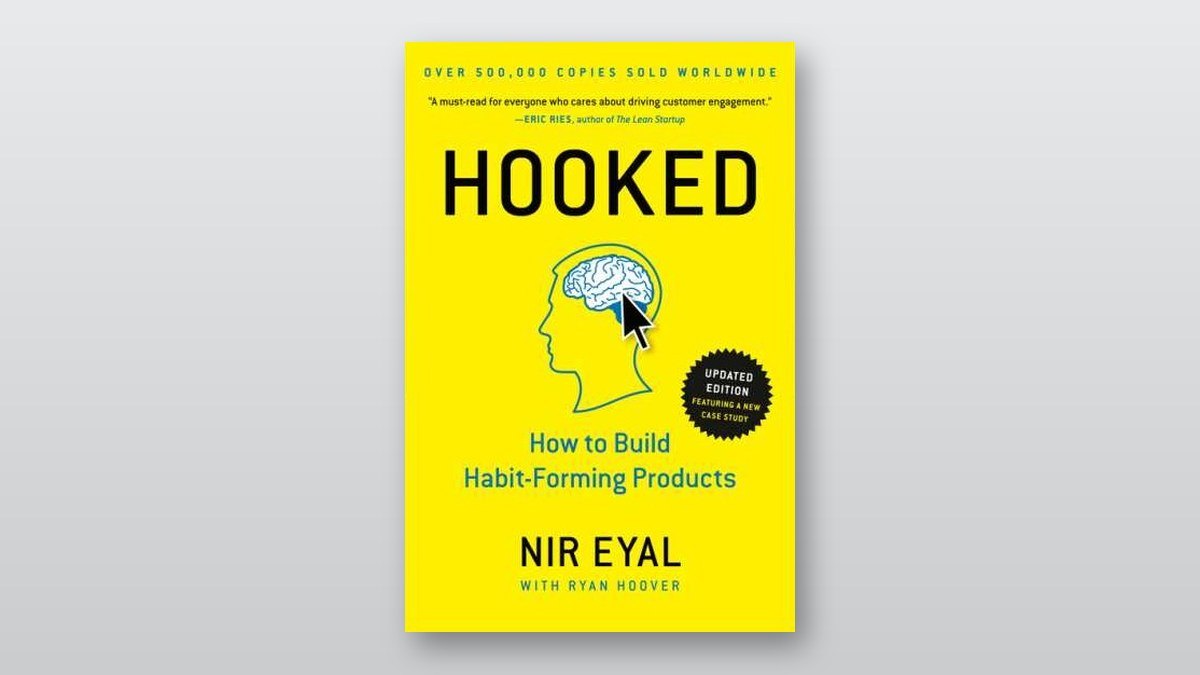
Hooked: How to Build Habit-Forming Products is a business book by Nir Eyal, credited on Open Library as written with Ryan Hoover, while Penguin Random House lists Hoover as editor. The Portfolio hardcover is dated November 4, 2014 at 256 pages and a $31.00 list price per the publisher. Its core idea, in the publisher's description, is the Hook Model, a four-step process that the author says is built into many successful products to bring users back without costly advertising. On the author's own site the four steps are Trigger, Action, Variable Reward and Investment, and the author also published a decision tool he calls the Manipulation Matrix.
This is a summary in our own words, drawn from the author's site, the publisher and Open Library, not from the text of the book. The big claims are Eyal's own, so we label them that way, and the sales takeaways further down are our analysis, not the book's. Hooked is written about consumer products, not selling, so treat the translation to sales as a thinking aid. For a habits-first companion, see our summary of The Compound Effect.
The author and the editions
Nir Eyal is the author. His book page describes him as a former instructor at the Stanford Graduate School of Business and the Hasso Plattner Institute of Design and a New York Times bestselling author, and says about 1 million copies have sold across three of his books, Beyond Belief, Indistractable and Hooked, combined. Those are the author's own descriptions. Credit for Ryan Hoover differs by source, so we state both.
- Publisher listing. Penguin Random House shows Hooked by Nir Eyal, edited by Ryan Hoover, as a Portfolio hardcover published November 4, 2014, at 256 pages and $31.00, with an e-book published the same day.
- Library records. Open Library lists a Portfolio/Penguin edition from 2014 at 242 pages with the credit line Nir Eyal with Ryan Hoover, and a separate Portfolio hardcover record dated November 4, 2014 at 256 pages. The first-publication year on the work record is 2014.
- Updated edition. The publisher says its listing is a revised edition updated with a new case study, and the author's book page also mentions an updated edition. We found no page we read that gives the date of the update.
Page counts differ by edition and record, and prices change, so check a retailer before you buy.
The big idea: habit-forming products
The publisher's description says the book explains the Hook Model, a four-step process embedded into the products of many successful companies to subtly encourage customer behavior. Through consecutive hook cycles, it says, these products reach their goal of bringing users back again and again without depending on costly advertising or aggressive messaging. It adds that the book draws on years of research, consulting and practical experience, and is a how-to guide rather than abstract theory. The description names the iPhone, Twitter, Pinterest and the Bible App as examples. All of this is the publisher's and author's framing of the book, not independent findings.
The description says the book is for product managers, designers, marketers, start-up founders and anyone who wants to understand how products influence behavior. Sellers are not named, which matters for how far the ideas travel in a sales job.
The Hook Model, step by step
The author lays out the model in his own article, How to Manufacture Desire. Our paraphrase of the four phases:
- Trigger. What prompts the user to act. External triggers, such as an email, a link or an app icon, come first. Over time the author says users feel an internal cue tied to a routine or emotion and return without being prompted.
- Action. The behavior the trigger was meant to produce. The author's guidance is to make it easy while also raising the user's motivation.
- Variable Reward. A payoff that varies in type or timing. The author's claim is that an unpredictable payoff creates a stronger urge to keep seeking it than a fixed one.
- Investment. Something the user puts in, such as time, data, effort, social connections or money. The author says this makes the product more valuable to the user and sets up the next trigger.
The author says each completed cycle reinforces the habit, so the user becomes more likely to return on their own. This four-part structure is the part of the book most often repeated, and it is the author's model, not an established law.
The Manipulation Matrix
Eyal published the matrix in a post titled The Morality of Manipulation on his site. It is a decision tool for asking whether you should build a habit-forming product, not whether you can. It asks two yes-or-no questions: would you use the product yourself, and would it materially improve users' lives? The answers place a product in one of four quadrants, which we paraphrase from the author's post.
- Facilitator (yes, yes). You would use it and believe it improves users' lives. The author sees this as building healthy habits.
- Peddler (no, yes). You believe it helps users but would not use it yourself. The author does not call this immoral but says success is unlikely because you lack the insight to build what people want.
- Entertainer (yes, no). You would use it but cannot honestly say it improves lives. The author treats it as legitimate entertainment or art, and says such products tend to fade and rely on constant new releases.
- Dealer (no, no). You would not use it and do not believe it helps users. The author calls this exploitation, done mainly for money.
Both questions rest on the builder's own honest self-assessment, which is the framework's main limit.
Key takeaways
These points are our reading of the book's themes as shown on the publisher and author pages, not quotes from it.
- Habits beat ads. The author argues that products people return to out of habit need less costly advertising and aggressive messaging.
- Think in cycles. The loop of trigger, action, reward and investment is meant to repeat, with each pass strengthening the next.
- Reward uncertainty draws people in. The author claims variability pulls harder than a predictable payoff.
- Users' own effort deepens attachment. What a user puts in raises the product's value to them.
- Ethics is part of the design. The Manipulation Matrix asks the builder to use the product and believe it helps.
What sellers can take from it
These ideas are our analysis of how the book's themes could apply to selling, not claims from the book. The book is about consumer products and we found no source that applies it to a sales process.
- Make the next step easy. The Action phase is about lowering effort. A short, specific next step with a calendar link, a one-page summary or a single question is easier to say yes to than an open-ended request.
- Use triggers that fit the buyer. The model starts with outside prompts. A well-timed follow-up tied to something the buyer cares about works as a trigger, while a generic check-in is easier to ignore.
- Invite buyer investment. Investment means the user puts something in. In a sale this can be sharing data for a tailored proposal, involving a colleague or running a small pilot, which our reading suggests also tells you how serious the buyer is.
- Be careful with variable reward. Unpredictable payoffs are a product-design idea. In selling, a steady supply of useful insight and honest answers builds trust, and gimmicks that keep buyers guessing risk the opposite.
- Run the matrix on your own offer. Before you push, ask whether you would buy this yourself and whether it would improve the buyer's situation. A no to either is a signal to qualify harder or walk away.
- Pair it with a deal-moving framework. Hooked is about getting people back, not closing. Pair it with a framework for stalled deals such as The JOLT Effect, or with the habits focus of The Compound Effect.
Limits to keep in mind
A few cautions, all our own reading rather than findings from the sources.
- Author-sourced claims. Most of what we can say about the book's promise comes from the author's site and publisher copy. We found no source in our reading that independently tests the Hook Model.
- Not a sales book. It targets product teams and marketers. Business purchases usually involve fewer repeat interactions and more people than a daily app, so the habit idea fits only in part.
- Manipulation risk. A model for shaping behavior can be misused, which is why the author adds the matrix. Using it as a selling script would cut against that spirit.
- Edition differences. Records disagree on page counts, so check which edition you are reading.
Questions people ask
Who wrote Hooked?
Nir Eyal. Open Library credits it as written with Ryan Hoover, while Penguin Random House lists Hoover as editor.
When was Hooked published?
Open Library gives 2014 as the first publication year, and Penguin Random House dates the Portfolio hardcover November 4, 2014.
How many pages is Hooked?
Penguin Random House lists 256 pages for the Portfolio hardcover, and one Open Library record lists 242 pages for a Portfolio/Penguin edition.
What is the Hook Model?
The author's four-step model of Trigger, Action, Variable Reward and Investment, which he says brings users back to a product repeatedly.
What is the Manipulation Matrix?
A decision tool from the author with two questions, would you use the product and would it materially improve users' lives, giving four quadrants: facilitator, peddler, entertainer and dealer.
Is Hooked a sales book?
No. It is about building habit-forming products. The sales takeaways on this page are our own analysis of how its ideas could apply.
How much does Hooked cost?
Penguin Random House lists the Portfolio hardcover at $31.00. Prices vary by retailer and edition.
Sources
- Penguin Random House: Hooked · Portfolio hardcover, November 4, 2014, 256 pages, $31.00, edited by Ryan Hoover; publisher description
- Open Library: Portfolio/Penguin edition · 2014, 242 pages, Nir Eyal with Ryan Hoover
- Open Library: Portfolio hardcover · November 4, 2014, hardcover, 256 pages
- Open Library: work record · First published 2014; book description
- NirAndFar: Hooked · Author bio, copies sold across three books, updated edition, four-step process
- NirAndFar: How to Manufacture Desire · The four phases of the Hook Model as the author explains them
- NirAndFar: The Morality of Manipulation · The Manipulation Matrix: two questions and four quadrants
This summary is an independent explainer written in our own words and does not reproduce the book. Facts were read from the linked pages on October 31, 2026; read the book for the primary detail and weigh the author's claims accordingly.