Running Lean by Ash Maurya — Cliff Notes Summary
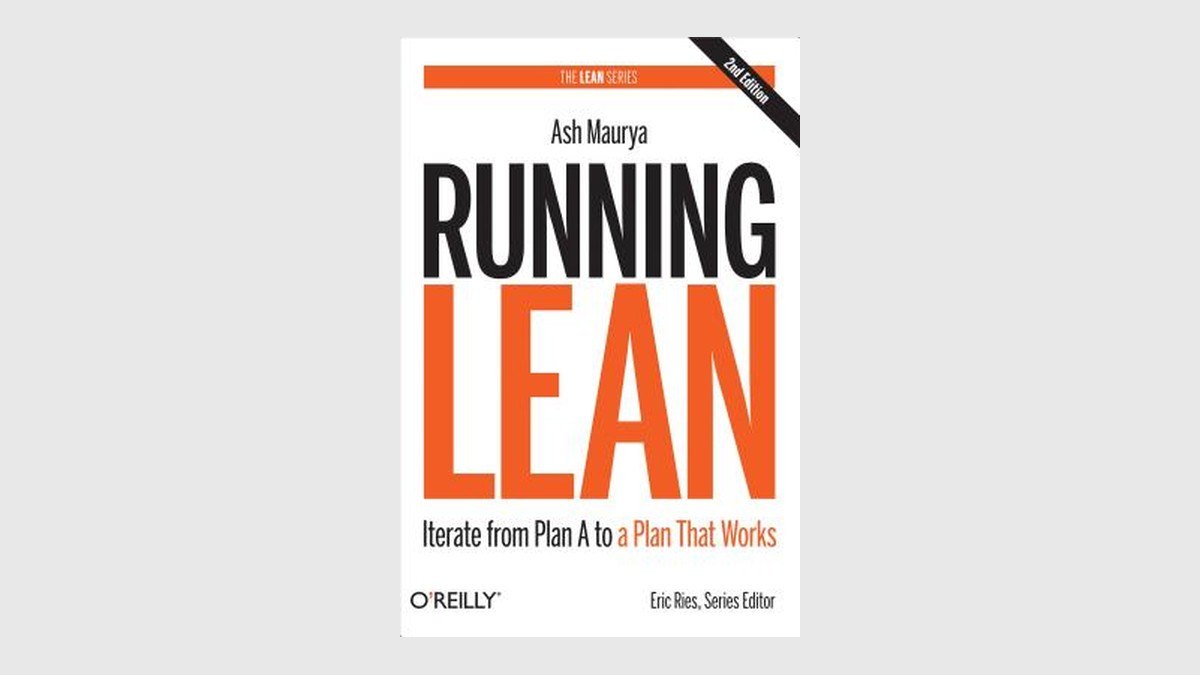
Running Lean by Ash Maurya is a step-by-step method for testing a startup idea before you pour money into building it. You write your plan on a one-page Lean Canvas, find the riskiest parts, test them with customer interviews, build only a minimum viable product, and then track whether the business is gaining traction. The title's promise is to iterate from Plan A to a plan that works.
The book facts below come from bookseller and author pages. Porchlight Books lists the 2nd edition from O'Reilly Media, published April 3, 2012, at 235 pages. Target lists the 3rd edition from O'Reilly at 367 pages and says it adds a continuous innovation framework. The author's own books page dates the 3rd edition to 2022 and says the book began as blog posts in 2009 and became a self-published book in 2011. This is a summary in our own words, based on those pages and a review, not a chapter-by-chapter retelling. We did not read the book itself.
The big idea
The Porchlight description frames the problem: many products fail because teams spend their time and money building the wrong thing. The book offers a systematic way to test product ideas and reach product/market fit, drawing on the Lean Startup, Customer Development and bootstrapping. The author's page describes the third edition as deconstructing your idea on a Lean Canvas, stress testing desirability, viability and feasibility, and validating with customers through evidence, not opinions.
Put the plan on a Lean Canvas
The LEANSpark Lean Canvas page says Ash Maurya created the Lean Canvas in 2010 as an adaptation of Alexander Osterwalder's Business Model Canvas for startups facing extreme uncertainty. It swaps four of the original boxes (Key Partners, Key Activities, Key Resources and Customer Relationships) for Problem, Solution, Key Metrics and Unfair Advantage. The idea is that an early venture needs to understand its problem and its metrics before it maps partners and resources.
The same page lists the canvas blocks as Customer Segments, Problem, Existing Alternatives, Unique Value Proposition, Solution, Key Metrics, Channels, Early Adopters, Cost Structure, Revenue Streams, Unfair Advantage and a High-Level Concept. The I-Programmer review describes the canvas as a one-page diagram, filled in during one sitting of under 15 minutes in place of a long business plan, and recommends showing it to at least one other person.
Find the riskiest assumptions
Every box on the canvas is a guess. The review says the book sorts risk into product, customer and market risk in Chapter 4 and uses the canvas to decide which to tackle first. In plain terms, you test the guess most likely to kill the business before you spend effort on the safe ones.
Problem and solution interviews
The review describes two kinds of customer conversation. The problem interview is a scripted talk with 10 to 15 people, aimed at learning whether the problem is real. The solution interview is a 25-minute session, with a separate 5-minute step for recording results. The author's page puts the principle simply: validate with customers through evidence, not opinions.
Build a minimum viable product
The review presents the MVP as just enough of the solution to measure how potential customers react, not a fully built product. The Porchlight description adds that the book covers small iterative tests and knowing when to pivot.
Traction and continuous innovation
The Target listing says the third edition covers traction roadmaps and finding a repeatable business model, and that it adds a continuous innovation framework, following one entrepreneur from an initial vision to a business model that works. The review of the older text points to Chapter 14, which defines a metric for measuring product/market fit. The author's page says the deeper treatment of metrics and traction, using the Customer Factory model, is in his sequel, Scaling Lean from 2016.
Editions: 2012 second edition and 2022 third edition
Two editions are in circulation. The 2nd edition (2012) is the one on the cover above, and its description centers on testing ideas and reaching product/market fit. The 3rd edition (2022) is longer and, according to the sellers and the author, adds the continuous innovation framework and a running story of one entrepreneur. We could only confirm the interview and chapter details from a review of the earlier text, so check the contents page of the edition you buy.
How it differs from The Lean Startup and Lean Analytics
- The Lean Startup: Eric Ries's book is the big-picture argument for build, measure, learn. Running Lean is the hands-on companion in the same Lean Series, and Porchlight notes the series is presented by Eric Ries. Read our Lean Startup summary for the philosophy.
- Lean Analytics: that book is about choosing and benchmarking the numbers. Running Lean touches metrics but spends its effort on the canvas, the interviews and the first tests. Our Lean Analytics summary covers the metrics side.
Put simply, The Lean Startup says why, Running Lean says how to start, and Lean Analytics says what to measure.
What it means for RevOps and sales leaders
This section is our own analysis, not something the book says.
- Test the pitch before the pipeline. Run a few problem interviews with target buyers before building a large outbound motion around a guess.
- Write down the assumptions. A canvas-style page for a new segment or offer makes the riskiest guess visible to the whole team.
- Pick one number. A single traction metric per stage keeps the weekly review focused.
Limits to keep in mind
We did not read the full text. The details come from bookseller pages, the author's pages and one undated review of an earlier text, so chapter numbers and interview formats may differ in the 3rd edition. The Lean Canvas page is run by the author's own company, so treat its framing as the author's view. Read the book for the full method.
Questions people ask
What is Running Lean about?
It is a method for testing a startup idea before building it: write the plan on a Lean Canvas, find the riskiest assumptions, test them in customer interviews, build a minimum viable product, and then track traction.
What is the Lean Canvas?
A one-page business model Ash Maurya created in 2010, adapted from the Business Model Canvas for startups facing extreme uncertainty. It adds Problem, Solution, Key Metrics and Unfair Advantage.
Which edition should I read?
The 2nd edition is from 2012 and the 3rd is from 2022. Sellers say the 3rd adds a continuous innovation framework and a running story of one entrepreneur.
How is it different from The Lean Startup?
The Lean Startup is the broad argument; Running Lean is the step-by-step playbook. See our Lean Startup and Lean Analytics summaries for the other two.
Is this a substitute for reading the book?
No. It is an independent summary in our own words from public pages. It is not affiliated with the author or the publisher.
Sources
- Porchlight Books: Running Lean · Publisher, April 3, 2012 date, 235 pages, description and cover image
- Target: Running Lean, 3rd Edition · 3rd edition page count, traction roadmaps and continuous innovation framework
- Ash Maurya: Books · 3rd edition 2022, history of the book, Scaling Lean
- LEANSpark: Lean Canvas · Lean Canvas creation, blocks and comparison with the Business Model Canvas
- I-Programmer: Running Lean review (undated) · Canvas timing, risk types, interview formats, MVP and metric chapter
- Our The Lean Startup summary · The Eric Ries book
- Our Lean Analytics summary · The metrics companion
This summary is an independent explainer written in our own words and does not reproduce the book. Facts were read from the linked pages on October 30, 2026; we did not read the full text of the book. Read the book for the full detail.