The 10X Rule Summary: Key Ideas from Grant Cardone's Book
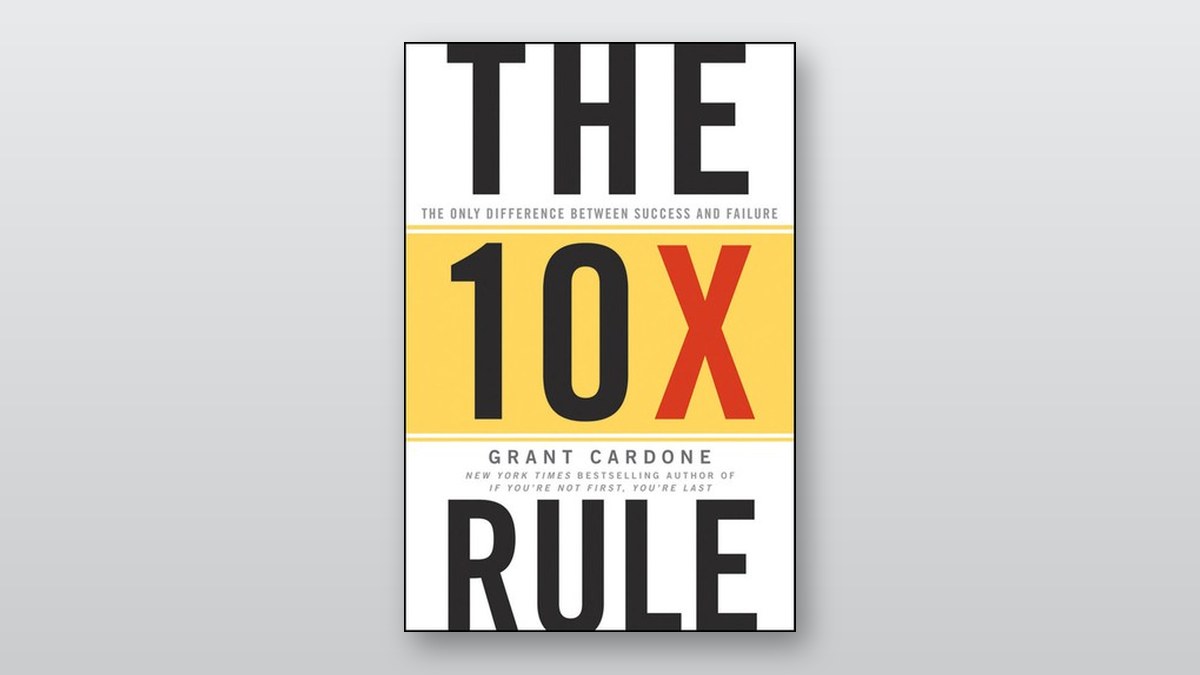
The 10X Rule by Grant Cardone argues that you should set targets ten times higher than you think you need and then take ten times the action you think is required. Cardone's claim is that most people fall short not because their goals are too big but because their goals are too small and their effort is too ordinary. Per Dan Silvestre's summary, success takes roughly ten times the effort, commitment, time and money most people expect to invest.
The book is *The 10X Rule: The Only Difference Between Success and Failure*, published by Wiley in April 2011 as a 256-page hardcover, per Wiley. This is a short summary in our own words, based on the publisher's description and published summaries, not a retelling of the book.
The author and the book
Wiley describes Grant Cardone as a bestselling author, international sales trainer and motivational speaker who founded three companies, including Cardone Training Technologies and Cardone Group (Wiley).
Wiley's description says the book argues that ambitious goals need a fourth level of effort, which Cardone calls Massive Action, or the 10X Rule. It also covers business jargon and fear of risk, why people get stuck at lower levels of effort, and how to make high effort a habit. Open Library lists English editions from John Wiley & Sons dating to 2011.
The core idea: 10X targets and 10X action
There are two multipliers. The first is the target: aim for something ten times bigger than what feels reasonable. The second is the effort: assume it will take about ten times the effort, time and money you first estimate. Dan Silvestre adds that if the goal turns out to be easier, you are pleasantly surprised, and if it is not, you were already prepared.
Cardone treats success as something you cause through action rather than something that happens to you, and frames it as a duty, according to Dan Silvestre. Most people, the summary says, set goals too low, underestimate the effort and underestimate the obstacles. The 10X mindset is meant to fix all three at once.
The four degrees of action
Chapter 7 of the book is titled Four Degrees of Action (O'Reilly listing). Labels vary slightly between summaries, but Dan Silvestre gives them as:
- Do nothing. No action at all.
- Retreat. Backing away from the goal.
- Take normal action. The average level most people settle for.
- Take massive action. The level Cardone says goals actually require.
The argument is that all four cost energy and time, so spending that energy on average or no results makes little sense. Massive action is presented as the natural state for anyone chasing a big goal.
Average is a failing formula
Normal action is the most dangerous option in Cardone's scheme because it feels responsible. Dan Silvestre says the book calls average thinking and actions a route to mediocrity and failure, and that it singles out the middle class as stuck in that cycle. VisioneerIT describes average action as a comfort zone where people show up, make some progress and treat setbacks as reasons to stop.
The practical point is that the book rejects phrases like "be realistic" as advice for ambitious people, and wants you to raise the target instead of lowering it.
Obsession and fear
Cardone says dominating a field takes obsession: your goals should dominate your thoughts and priorities. Without it, Dan Silvestre says, you spend your life making excuses. VisioneerIT stresses that this is meant as maximum deliberate effort, not reckless effort, but note that site is a services firm with a favorable view.
On fear, the book reads the word as an acronym, False Events Appearing Real, and says to act quickly when afraid because waiting lets fear grow. It also warns against over-preparing: failing while doing something beats failing while preparing (Dan Silvestre).
How a sales team can apply it
Cardone is a sales trainer, and the book's ideas translate into a few habits for a team. These are our reading of the summaries, not rules from the book.
- Set the target above the plan. Quotas built to be safely hit invite normal action. A stretch target forces the team to ask what it would take.
- Estimate effort honestly, then pad it. The ten-times assumption on effort, time and money is a planning habit: assume the pipeline, calls or follow-up will take more than you think.
- Act before you feel ready. The anti-fear advice maps to prospecting: make the call rather than rehearse for another week.
- Win the customer first. Dan Silvestre says Cardone puts acquiring customers first and satisfaction second, then over-delivers once you have them. Teams should decide for themselves how far to follow that.
- Pair it with a method. Volume without a process wastes effort. Combine it with discovery questions from SPIN Selling or qualification habits from the Sandler Selling System.
Cardone's own site presents the 10X Rule as finding what top competitors will not do and doing that at far higher intensity, and it also promotes a paid event, so read it as marketing (Grant Cardone).
Criticisms and limits
- Burnout and sustainability. A critical opinion piece on Jyotirgamya argues that relentless high output without recovery leads to exhaustion and falling performance, and that falling short of extreme targets can cause shame. That site promotes its own alternative approach, so treat it as advocacy.
- Effort does not scale evenly. The same piece says output does not rise in a straight line with effort because of diminishing returns, and that the book's neuroscience claims are oversimplified.
- One size does not fit all. Critics say the rule ignores differences in resources, circumstances and personality.
- It is not research. VisioneerIT calls the book extreme and says it is a business book, not a scientific study.
- Hustle-culture tone and repetition. Reader reviews we found on blogs and book sites praise the clear call to think bigger but complain about repetition and an aggressive tone, and one review says the book does not separate high-value effort from low-value effort.
Questions people ask
What is the 10X Rule?
Grant Cardone's idea that you should set targets ten times higher than you think you need and take ten times the action you think is required.
What are the four degrees of action?
Per Dan Silvestre's summary: do nothing, retreat, take normal action and take massive action. Cardone argues only the last produces 10X results.
Who wrote The 10X Rule and when was it published?
Grant Cardone wrote it, and Wiley published it in April 2011 per Wiley's product page.
Does the 10X Rule lead to burnout?
Critics say relentless effort without recovery can. The strongest critiques we found are opinion pieces, and we found no study of the rule itself, so judge the pace for yourself.
Is the 10X Rule useful for sales teams?
It can push stretch targets and quick action, but it is a mindset book, not a selling method. Many teams pair it with a process such as SPIN Selling or the Sandler system.
Is the 10X Rule worth reading?
Readers praise its call to think bigger and dislike its repetition and hustle tone. It suits people who want motivation more than evidence.
Sources
- Wiley: The 10X Rule product page · Publisher description, April 2011 date, page count and author bio
- Open Library: The 10x rule · Editions and 2011 publication
- O'Reilly: The 10X Rule, Chapter 7 · Chapter title Four Degrees of Action
- Dan Silvestre: The 10X Rule summary · Four degrees, average, obsession, fear and targets
- VisioneerIT: Cardone's 10X Rule summary · Massive action, fear, average and limits
- Jyotirgamya: 10X Rule alternatives · Burnout and sustainability critique (opinion)
- Grant Cardone · The author's own framing of the 10X approach
This summary is an independent explainer written in our own words and does not reproduce the book. Facts were read from the linked pages on October 20, 2026. We did not have the full text of the book, so for exact wording and chapter detail, read the book itself.
Top photo: Book cover via Open Library