Sandler Selling System Summary: Key Ideas from David Sandler's Book
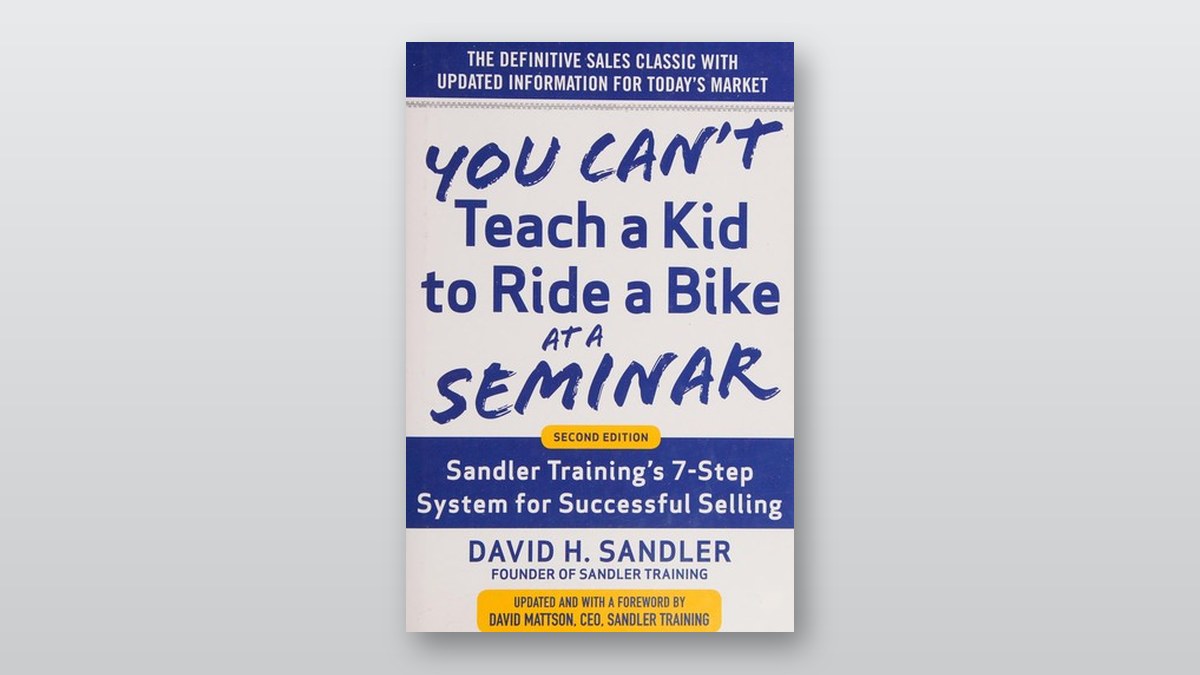
The Sandler Selling System, taught in David Sandler's book *You Can't Teach a Kid to Ride a Bike at a Seminar*, treats selling as an equal, adult-to-adult conversation, not a pitch. The seller guides a "dance" in which the buyer states the problem, the budget and how they decide before any solution is shown. The method is usually drawn as a submarine with seven compartments: bonding and rapport, up-front contract, pain, budget, decision, fulfillment and post-sell, each sealed before the next.
The core rule is that fulfillment, the presentation, comes late. Per Sandler Training, the approach is low-pressure and consultative and puts the salesperson in control of the discovery process.
This is a short summary in our own words, not a retelling of the book. It follows the revised second edition published in 2015 (see the edition note below), and we did not have the book's full text.
The book and where the system comes from
The book is *You Can't Teach a Kid to Ride a Bike at a Seminar*. Open Library lists the original by David H. Sandler and John Hayes, published by Dutton in 1995 at 226 pages, and a hardcover in September 1996 with the subtitle *The Sandler Sales Institute's 7-Step System for Successful Selling*. The title makes the point that selling skill comes from practice, not from sitting through a class.
Edition note: this summary follows the revised second edition, published by McGraw Hill on March 2, 2015, under the subtitle *Sandler Training's 7-Step System for Successful Selling*. The publisher page credits David Sandler and David H. Mattson and says it keeps Sandler's classic advice while adding skills for a more complex sales landscape. Open Library lists 288 pages for that edition, though other listings give different counts. Facts about the system below come from Sandler Training's own pages and other linked sources; we did not have the full text of either edition.
Per Salesforce, David H. Sandler created the system in 1966 and it has been used for more than 50 years, with training offered through franchise locations in more than 28 countries. Sandler Training says Sandler teamed up with a clinical psychologist to design an approach meant to break traditional stereotypes of salespeople.
The buyer-seller dance
The publisher's contents list a chapter on the selling dance. As we read it, the idea is that a sale is a back-and-forth between two adults, each leading and following, and not a seller delivering a pitch to a passive audience. The seller's goal is to guide a conversation in which the buyer states the problem, the cost and the decision rules, so nobody is pressured and nobody is guessing.
Sandler Training describes the approach as low-pressure and consultative and says it puts the salesperson in control of the discovery process. That is control of the conversation, not of the buyer.
The Sandler Submarine: seven compartments
Sandler teaching is often drawn as a submarine with seven compartments the seller passes through in order. Sandler Training's own page lists the seven steps without using the word submarine; the image appears in Sandler training materials and third-party guides. The idea is that you seal one compartment before entering the next, which is why skipping steps is the cardinal sin.
- Bonding and rapport. Build equal business standing and open, honest communication.
- Up-front contract. Agree roles and ground rules for the meeting.
- Pain. Uncover the problems and what they cost the buyer.
- Budget. Find out whether the buyer is willing and able to invest.
- Decision. Learn who decides, how and when.
- Fulfillment. Present a solution that fits the pain, budget and decision process.
- Post-sell. Confirm next steps and guard against buyer's remorse.
Third-party guides group these into three phases: building the relationship (bonding and the up-front contract), qualifying (pain, budget and decision) and closing (fulfillment and post-sell).
Bonding, rapport and the up-front contract
Bonding is about equal standing. The seller is not a supplicant begging for time and not a superior lecturing, but a peer exploring whether there is a fit.
The up-front contract is not a sales contract. Salesforce describes it as ground rules such as meeting length, frequency and expected outcomes, and Sandler Training's wording is to establish roles and ground rules for a comfortable environment. Third-party guides add that the agreement includes the buyer's freedom to say no, which is the point: a clear no early is better than a vague maybe later.
Pain: the pain funnel
Sandler Training says this step identifies the buyer's problems and their potential impact as reasons to do business. The technique is the pain funnel: per Salesforce, open-ended questions that explore the buyer's challenges, past attempts to solve them and how they feel about them. Sources disagree on how many questions the funnel has, so treat any fixed count as one trainer's version.
The logic is that people buy to escape a cost, not to acquire features. Third-party guides say that if there is no real pain, the rep should stop and not demo. Compare the same idea in our Gap Selling summary, which builds on the gap between current and desired state, and the Solution Selling summary, which centers on pain and vision.
Budget and decision
Sandler Training's page says to discover whether the prospect is willing and able to invest the time, money and resources needed to fix the problem. Salesforce adds that if the budget, staff and commitment are not there, either side can step away. The publisher's contents list a chapter on discussing money, so the book treats it as its own skill, and money comes up before the proposal, not after.
The decision step covers the who, when, what, where, why and how of the buyer's buying process. The publisher also lists a chapter on qualifying decision-making ability. Qualifying here means checking that the person you are talking to can actually decide, and that you know what else must happen before they do.
Fulfillment and post-sell
Only now does the seller present. Sandler Training describes fulfillment as a solution that addresses the problem, fits the budget and matches the decision process. Because the earlier steps agreed all three, the presentation should hold no surprises. This is why the system pushes back on feature-and-benefit selling, which the publisher's contents list as its own chapter.
Post-sell is where the book covers buyer's remorse. Sandler Training says this step sets next steps, discusses future business and guards against losing the sale to a competitor or to second thoughts.
Sandler's rules
Sandler Training also teaches numbered Sandler Rules. Its blog lists several:
- Rule #3, no mutual mystification. Both sides stay clear and aligned instead of guessing.
- Rule #12, answer every question with a question. The reversing habit that keeps the buyer talking.
- Rule #25. When you want to know the future, bring it back to the present.
- Rule #27. Buyers must discover they want it; you cannot sell them anything.
- Rule #34, work smart, not hard. Use effective methods, not sheer effort.
Sandler Training also publishes 5 rules of prospecting: focus on your actions, not your results, and keep prospecting even when you do not enjoy it. Rule numbers and wording vary between sources, so check the book before quoting one.
Reversing is explained by Sandler UK: answering a prospect's question with your own, softened with a lead-in like "I understand" and short follow-ups such as "Which means?". Sandler UK separates it from negative selling, which uses fear or misleading claims.
How a sales team applies it today
- Open every meeting with an up-front contract. Purpose, time, what each side wants and the right to say no, written into the invite or agenda.
- Match CRM stages to the compartments. Stages for pain, budget and decision stop reps from advancing deals on hope.
- Coach the questions. Managers review calls for open questions and for pitches given too early.
- Train as a team. Salesforce notes it needs whole-team buy-in and ongoing reinforcement, and is not set-it-and-forget-it.
Salesforce lists benefits including ease of learning, more predictable closing and filtering out poor-fit prospects, though it cites no performance statistics. Teams selling to complex buying groups often pair Sandler's qualification habits with a framework built for that, such as the New Strategic Selling summary.
Criticisms and limits
- Not for every sale. Reviews say it fits less well in highly transactional or low-ticket selling, and one review says it should not be used for technical, complex or enterprise sales. The second edition's appendix on enterprise selling suggests Sandler Training disagrees, so judge for yourself.
- Depends on skill. It relies on questioning and listening, and weaker reps need practice.
- Can feel scripted or intrusive. Reviewers warn that direct qualification questions can annoy buyers who have already researched on their own, and can damage trust where they come without context. Salesforce says negative reverse selling must be used carefully so it does not offend.
- Can clash with a hard-charging style and lengthen cycles. Salesforce notes the first, and reviews note the multiple touchpoints.
Questions people ask
What is the Sandler Selling System?
A seven-step selling process taught by Sandler Training and in David Sandler's book. Per Sandler Training it is low-pressure and consultative, with the seller guiding discovery before presenting a solution.
What are the seven steps of the Sandler Submarine?
Bonding and rapport, up-front contract, pain, budget, decision, fulfillment and post-sell. Third-party guides say the first two build the relationship, the next three qualify the buyer, and the last two close and protect the sale.
Who wrote the book?
The original was written by David H. Sandler with John Hayes (Dutton, 1995, per Open Library). The second edition, published by McGraw Hill on March 2, 2015, is credited to David Sandler and David H. Mattson.
What is an up-front contract in Sandler selling?
Not a sales contract. It is an agreement on ground rules for the meeting, such as length and expected outcomes, per Salesforce and Sandler Training. Third-party guides add the buyer's right to say no.
Is the Sandler method manipulative?
Sandler UK separates its reversing technique from negative selling, which uses fear or misleading claims. Some reviewers say the questions can feel intrusive if used as a script, so how it is used matters.
Is the Sandler system still worth using?
Many teams use it for its qualification discipline. Reviews say it fits less well in transactional or very complex sales, and we found no independent study comparing its results to other methods.
Sources
- Open Library: You can't teach a kid to ride a bike at a seminar (work) · Original authors, publisher and 1995 and 1996 editions
- Open Library: second edition record · McGraw-Hill 2015 edition, authors, page count and cover
- McGraw Hill: 2nd Edition product page · Publisher description, publication date and contents
- Sandler Training: Sandler Selling System · The seven steps in Sandler's own words
- Sandler Training: From the Top, favorite Sandler Rules · Numbered Sandler Rules
- Sandler Training: 5 Sandler Rules of Prospecting · Prospecting rules
- Sandler UK: Negative Reverse Selling · Reversing technique
- Salesforce: The Sandler Selling System · History, steps, benefits and limits
This summary is an independent explainer written in our own words and does not reproduce the book. Facts were read from the linked pages on October 20, 2026. We did not have the full text of either edition, so for exact wording, rules and chapter detail, read the book itself.
Top photo: Book cover via Open Library