The Effortless Experience by Dixon, Toman & DeLisi — Cliff Notes Summary for Sellers
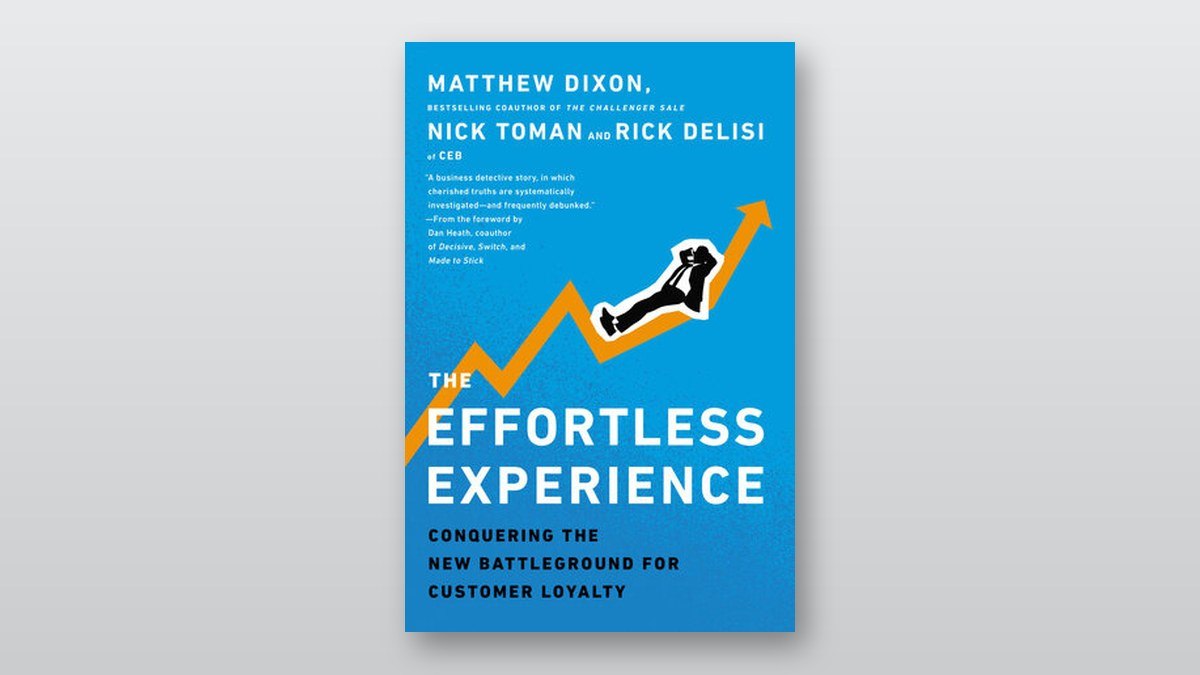
The Effortless Experience: Conquering the New Battleground for Customer Loyalty is a business book by Matthew Dixon, Nick Toman and Rick DeLisi, published by Portfolio on September 12, 2013 at 256 pages (Penguin Random House). Its argument is that customer loyalty depends more on reliably solving everyday problems than on dazzling service, so companies should work to reduce the effort customers have to spend instead of trying to delight them. The research behind it was done at CEB, the advisory firm that also produced *The Challenger Sale*.
For sellers, the book is less about selling and more about what happens after the sale. It is a useful lens for anyone whose customers renew, expand or leave based on how hard the company is to deal with.
This page is a summary in our own words. We did not read the full book; it draws on the publisher pages, the authors' 2010 Harvard Business Review article page and three secondary write-ups, all linked below.
What the book is and who wrote it
The Penguin Random House page lists the US edition as a Portfolio hardcover at $31.00, credits all three authors, and notes that Dixon also co-authored *The Challenger Sale*. The Penguin UK page lists a Portfolio Penguin paperback dated 26 September 2013.
That UK page describes Dixon as executive director of the Financial Services and Customer Contact Practices at CEB, and Nick Toman as a managing director in CEB's Sales and Marketing Practice. It gives no biography for Rick DeLisi. If you want the authors' earlier work on selling, see our Challenger Sale summary and our Challenger Customer summary.
The research behind it
The publisher says the book rests on five years of research with tens of thousands of respondents. The idea started as an article: the Harvard Business Review page shows "Stop Trying to Delight Your Customers" in the July-August 2010 issue, by Matthew Dixon, Karen Freeman and Nick Toman, which challenges the belief that companies must delight customers.
A Renascence write-up, from a customer experience consultancy, says the CEB study covered more than 75,000 people who had used a contact centre or other service channel, and that Gartner acquired CEB in 2017. We could not read the full HBR article, so we are relying on that account for the sample size.
The central argument
According to the publisher's description, the authors found that "wowing" customers does not reliably predict repeat purchases, share of wallet or positive word of mouth, while customers punish bad service more than they reward good service. In plain terms, a company gets more loyalty by removing friction than by adding flourishes.
The Renascence write-up reports the same pattern: customers whose expectations were exceeded were only marginally more loyal than those whose expectations were simply met, while repurchase intent fell and negative word of mouth rose as effort went up. It adds that a second or third contact about the same issue is a clear sign of a high-effort failure.
A newsletter by Jay Nathan for chief customer officers, citing Dixon, repeats a more dramatic figure: 96% of customers with a high-effort interaction became disloyal, against 9% with a low-effort one (Chief Customer Officer newsletter). We did not find that figure on a CEB, Gartner or publisher page, so treat it as a second-hand citation.
What makes customers disloyal
A Shortform summary says four of the five main reasons customers become disloyal are tied to effort. The biggest is having to contact the company more than once. The others are generic service, having to repeat the same information, and doing extra work to get a problem fixed.
Shortform is a commercial summary service, so this is a reading of the book, not the book's own text. Still, it fits the publisher's framing that the unglamorous basics matter more than the memorable moments.
The four pillars and the effort score
Both publisher pages say the book sets out four pillars of a low-effort customer experience, backed by case studies, customer profiles and practical tools. Neither page names the pillars, and we did not read the book, so we will not guess at the authors' exact wording.
The Chief Customer Officer newsletter lists four practices of its own: deal with the likely next issue before the customer raises it, adopt the customer's own language, give help in context instead of generic FAQs, and let frontline staff use judgment instead of rigid scripts. That is the newsletter author's framing, so do not read it as a table of contents for the book.
The research also produced the Customer Effort Score, a survey measure that asks how easy it was to resolve an issue. Renascence describes it as a single question on a five or seven point scale, and Shortform says it is usually asked after a transaction and cannot assess the whole relationship.
Criticisms and limits
Every source we read is either a publisher page or a commercial write-up that agrees with the book, so we did not find a critical review. Several of the write-ups come from businesses that sell customer experience help.
Our own judgment: the research is about service interactions, so applying it to a long enterprise sales cycle is an extension, not something the sources show. The sources also do not tell us how the findings differ across industries or customer types. We have not tested any of the claims.
What it means for sellers
- Sell the low-effort experience. If the book's argument holds for your buyers, a pitch about how little work your product or service creates for them may land better than one about extras.
- Look at repeat contacts. A customer who has had to reach out several times about one problem is, by the sources' account, at risk. That is a cue to check in before renewal, not after.
- Make handoffs easy. Having to repeat information is on the disloyalty list. A clean handoff from sales to onboarding to support is a concrete way to avoid it.
- Use plain words. Describing problems in the customer's own language, rather than internal jargon, is one of the practices the newsletter credits to Dixon's work.
- Ask what effort costs them today. Questions about how many steps, contacts or workarounds a process takes can reveal a buyer's pain without leading with a feature.
For a book on how customers are pushed to decide, see our Jolt Effect summary.
Questions people ask
Who wrote The Effortless Experience and when was it published?
Matthew Dixon, Nick Toman and Rick DeLisi wrote it, and Portfolio published the US hardcover on September 12, 2013, according to the Penguin Random House page.
What is The Effortless Experience about?
It argues that customer loyalty depends more on reliably solving everyday problems than on delighting customers, so companies should reduce customer effort, per the publisher.
Is it related to The Challenger Sale?
Only by authorship and research home. The publisher page says Dixon also co-authored *The Challenger Sale*, and the research was done at CEB. The two books cover different topics.
What is the Customer Effort Score?
A survey measure from this research that asks how easy it was to resolve an issue, usually after an interaction, as described by Renascence and Shortform.
Is this summary a substitute for the book?
No. We did not read the book itself. This page is written in our own words from publisher pages and secondary write-ups, so read the book for the authors' full argument and the four pillars.
Sources
- Penguin Random House product page · Authors, imprint, date, pages, price and description
- Penguin UK product page · UK edition date and author roles at CEB
- Harvard Business Review article page · 2010 article by Dixon, Freeman and Toman that preceded the book
- Renascence write-up on Gartner effort research · Sample size, findings and CEB-Gartner history
- Chief Customer Officer newsletter · Second-hand 96% and 9% figures and a practitioner's four practices
- Shortform summary · Drivers of disloyalty and the effort score
- Penguin Random House cover image · Cover image of the Portfolio edition
This summary is an independent explainer written in our own words and does not reproduce the book. Facts were read from the linked pages in November 2026; check the book itself for the authors' exact arguments. The seller suggestions are our own.
Top photo: Book cover via Portfolio / Penguin Random House