Transformed by Marty Cagan — Cliff Notes Summary
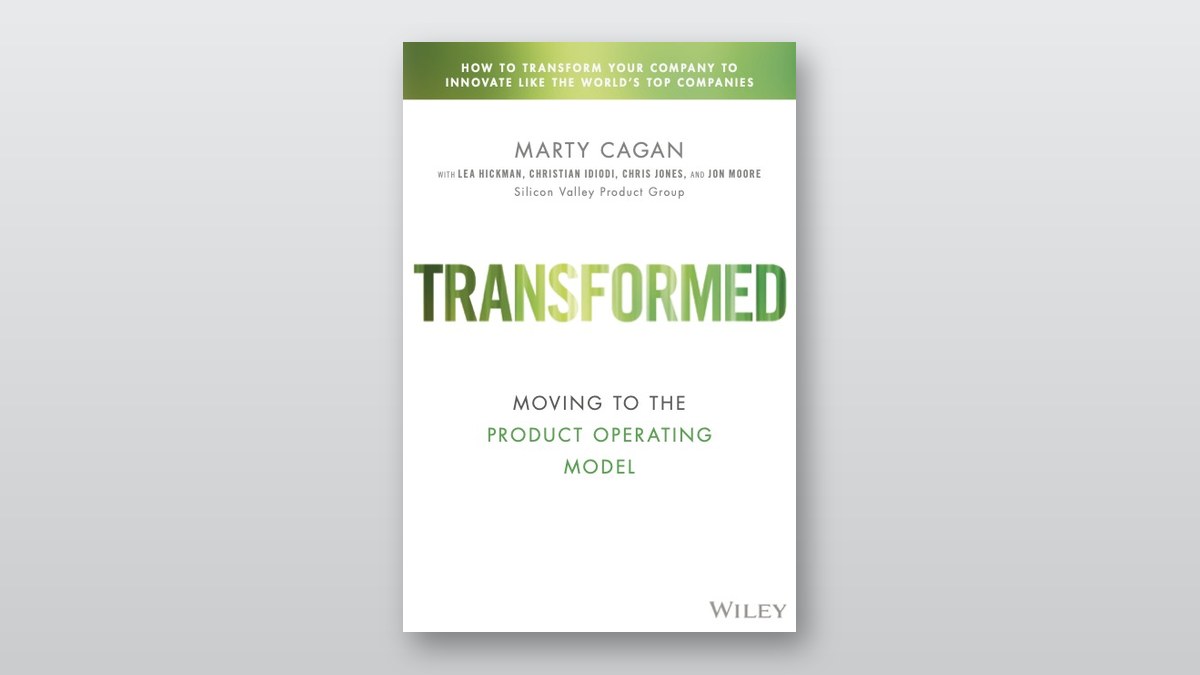
Transformed: Moving to the Product Operating Model is a book by Marty Cagan with his Silicon Valley Product Group (SVPG) partners Lea Hickman, Christian Idiodi, Chris Jones and Jon Moore, published by Wiley in March 2024 at 368 pages in hardcover (Wiley). It is the follow-up to *Inspired* and *Empowered*, and it tackles a different question: not how great product teams work, but how a company that works very differently today can actually change to the product model. Its stated goals are to explain the product operating model, to convince readers with case studies of successful transformations, and to inspire them with examples of product innovation.
For sellers, the useful part is that it explains what a company moving to this model is trying to become, and it has chapters on how product teams partner with sales and on the objections sales people raise.
This page is a summary in our own words. We did not read the book itself; it draws on the publisher's page and sample chapter, the table of contents, the authors' firm and three secondary write-ups, all linked below.
What the book is and who wrote it
The Wiley product page lists the book in the Silicon Valley Product Group series, with a hardcover at $34.00 and an e-book at $20.00. It says the book was written by the five SVPG partners, each of whom built products for decades, first as a product creator and then as a product leader.
The SVPG book page says Marty Cagan founded SVPG in 2001 and that before that he was an executive who defined and built products at Hewlett-Packard, Netscape Communications and eBay. The same page describes the book as a sequel to *Inspired* and *Empowered* whose purpose is to help companies move from their current way of working to the product model. If you want the earlier books first, see our Inspired summary and our Empowered summary.
The question it answers
In the Chapter 1 sample, the authors say *Inspired* shared the practices of top product teams and *Empowered* shared the practices of top product leaders. They say the most common question they get back is whether a company that operates very differently can change to the product model at all, and how. *Transformed* is their answer.
The same chapter says that for the past 20 years SVPG has been helping companies through these changes, and that most companies find the product model's ways of working very foreign. It quotes one CEO comparing the change to switching from driving on the right side of the road to the left, but gradually. It also says readers who know the earlier books will recognize the components of the product model, but those books do not cover how to make the change.
The sample also takes on the objection "we're not a tech company." According to the authors, "tech company" in this sense describes how a company believes it should power its business, not what it sells, and they point to Tesla, Netflix, Google, Airbnb and Amazon as examples of different products built the same way.
Who it is written for
The Chapter 1 sample lists five kinds of reader: members of product teams, product leaders, senior executives (especially the CEO and CFO), other executives, stakeholders and employees affected by the model, and product coaches. The SVPG page says the change leaders it has in mind start with the CEO.
How the book is laid out
The table of contents shows 11 parts and 49 chapters. Here is the shape, in our words:
- Part I, Introduction. Who the book is for, what a product operating model is, why to transform, what a typical transformation looks like, and the role of the CEO.
- Part II, Transformation Defined. Three chapters titled Changing How You Build, Changing How You Solve Problems, and Changing How You Decide Which Problems to Solve.
- Part III, Product Model Competencies. Chapters on product managers, product designers, tech leads and product leaders, including short sections on product ops and the impact of AI on product teams.
- Part IV, Product Model Concepts. Product teams, strategy, discovery, delivery and culture, organized around named principles such as outcomes over output, trust over control and learning over failure.
- Part VI, The Product Model in Action. How product teams partner with customers, sales, product marketing, finance, stakeholders and executives.
- Part VIII, Transformation Techniques. An assessment, tactics for competencies, concepts and adoption, evangelism, and profiles of seven product coaches.
- Part X, Overcoming Objections. Objections from customers, sales, the CEO and board, line of business, customer success, marketing, finance, HR, the CIO, the PMO and people inside product.
- Part XI, Conclusion. Keys to successful transformation and a closing innovation story.
Parts V, VII and IX are transformation stories about Trainline, Datasite and Adobe, and the book also has innovation-story chapters on Almosafer, Carmax, Gympass, Datasite, Kaiser Permanente and Trainline. We have not read these, so we can't say what they conclude.
What reviewers say the model is
A summary on TheScrumMaster.co.uk, a Scrum and agile training site, describes the product operating model as built around small cross-functional teams of a product manager, a product designer and engineers, held accountable for outcomes instead of tasks and funded by mission instead of by project. It lists five principles: empowered product teams, product strategy over roadmaps, outcome-based goals, strong product leadership, and a culture of trust and learning.
The Product Compass write-up, published in March 2024 as a conversation with Cagan before release, gives the author's view that the best product organizations do three things differently: how they build (small, frequent releases), how they solve problems (empowered teams held to outcomes, not outputs), and how they decide which problems to solve (a single strategy from leadership). The interviewers say their own extra commentary is theirs, not the book's.
How a company is meant to make the change
The reviewers agree on a few practical themes. Per TheScrumMaster.co.uk, renaming project managers as product managers or teams as squads does not make a product company, the transformation takes years rather than months, and it should start with a pilot instead of a partial rollout. The Product Leader Academy summary likewise says to start with pilots, show wins measured in outcomes rather than feature counts, and scale gradually, with leaders moving from control toward coaching.
These are reviewers' readings, not our reading of the book. The table of contents suggests the book itself gives this more room than the reviews do, with an assessment chapter, three tactics chapters and a section on setbacks, but we can't confirm what those chapters recommend.
Criticisms and limits
The write-ups we read are positive or descriptive, and we did not find a critical review among them. Two of them come from sites that teach or coach this way of working, and one is a conversation with the author, so none is neutral.
Our own judgment: a book written by the people who sell advisory help on this model is likely to make the case for it, and the reviews we read do not test how often these transformations succeed. Case studies from companies the authors worked with are evidence, not proof. We have not tested the book's claims.
What it means for sellers
- Learn which stage the account is in. A company that is mid-transformation may be reorganizing teams, funding and goals at once, which could change who is involved in a purchase.
- Expect a different conversation with product teams. The book describes teams held to outcomes, so a pitch tied to a result they own should be easier to place than a feature list.
- Read the sales chapters. The contents list a chapter on partnering with sales and another on objections from sales. If you sell into product organizations, those are the two chapter titles most likely to matter to you, though we have not read them.
- Expect executives to matter. The authors write for CEOs and CFOs as well as product teams, so a transformation may be a top-level decision, not only a product-team one.
- Be careful with the label. Many companies will say they are "transforming." The reviewers' warning that renaming roles is not the same as changing how work is funded and decided is a good reason to ask what has actually changed.
For how teams talk to customers, see the Continuous Discovery Habits summary.
Questions people ask
Who wrote Transformed and when was it published?
Marty Cagan wrote it with Lea Hickman, Christian Idiodi, Chris Jones and Jon Moore, and Wiley published it in March 2024, according to the Wiley product page.
What is Transformed about?
How a company moves to the product operating model. It follows *Inspired* and *Empowered* and aims to explain the model, show case studies of companies that changed, and show what product innovation they achieved, per the publisher and SVPG.
Do I need to read Inspired and Empowered first?
The authors say in the Chapter 1 sample that readers of the earlier books will recognize the product model's components, and that newcomers get the concepts they need as a foundation in this book. We have not read the full books, so check them yourself.
Who is Transformed written for?
Anyone helping a company move to the product model, from product teams and leaders to the CEO, CFO and product coaches, per the Chapter 1 sample.
Is this summary a substitute for the book?
No. We did not read the book itself. This page is written in our own words from the publisher's page, a sample chapter, the table of contents and three secondary write-ups, so read the book for the full argument.
Sources
- Wiley product page · Authors, publisher, date, page count, prices, description and goals
- SVPG book page · Author background, purpose and audience
- Wiley table of contents (PDF) · Parts, chapter titles and case-study names
- Wiley Chapter 1 excerpt (PDF) · Audience, the question the book answers, relation to Inspired and Empowered
- TheScrumMaster.co.uk summary · Reviewer's summary of the model and transformation advice
- Product Leader Academy summary · Second summary, pilots and outcomes
- Product Compass conversation with Marty Cagan · March 2024 interview write-up, three things the best product organizations do differently
- SVPG cover image · Cover image of the Wiley edition
This summary is an independent explainer written in our own words and does not reproduce the book. Facts were read from the linked pages in November 2026; check the book itself for the authors' exact arguments. The seller suggestions are our own.
Top photo: Book cover via Wiley / SVPG